Before this project, I had never listened to a U2 album. Then I chose a year-end where U2 were represented so much that I already had 1/3 of their album listened to before I even heard the first track and I figured there was no point with putting off the inevitable. With their magnum opus The Joshua Tree, U2 were absolutely everywhere in 1987 and 1988. Then they changed up their sound to allow for more electronic and modern elements for their follow-up Achtung Baby and they were all over the radio again.
U2 was the most commercially successful rock band of 1992. As I mentioned in the introduction, they were the most represented band of year on the charts, with five songs eligible for this countdown. Not only that, but four of the songs reached the eligible list on both the Modern Rock and Mainstream Rock charts, with just twelve songs crossing over on said charts. Such was the popularity of U2, that two versions of their single “Even Better Than The Real Thing” became successful in the UK, with equal chart success. And they were just a hair away from having a sixth song being eligible: “The Fly” ranked at 78th on the Modern Rock charts in 1992. It would have made it had the song not come out right around the end of the previous Billboard year. All this led to Achtung Baby selling some 18 million copies around the world. I’ve always considered U2 to be a bit overrated, as I find many of their hit songs, specificially the ones before Achtung Baby, to be so similar in sound that they can be hard to tell apart. But with songs like these, perhaps their massive success in 1992 was warranted.
![One [Single] by U2 (CD, Feb-1992, Island (Label)) for sale online | eBay](https://i.ebayimg.com/images/g/ceIAAOxywh1TF11f/s-l600.jpg)
“One” – U2
Pop
#10 peak (May 16, 1992)
#60 year-end, 20 weeks on chart
Modern Rock
#1 peak (April 4, 1992)
#1 year-end, 23 weeks on chart
Mainstream Rock
#1 peak (April 18 – April 25, 1992)
#7 year-end, 20 weeks on chart
UK
#7 peak (March 14, 1992)
#44 year-end, 6 weeks on chart
Much like with my #3 on my last best list, I don’t really know what to say about “One” that hasn’t been said before. Like “Hotel California,” it is a song that is universally considered great. Like “Hotel California,” it is a song that I have heard so many times in instances where I didn’t ask to hear it that I’ve never given the song much thought. And since I don’t know as much as U2 as Eagles, the task has become infinitely tougher. Let’s try this again.
When they went to the studio in Berlin to record Achtung Baby in 1990, three years after becoming the biggest band in the world with The Joshua Tree, U2 were at a crossroads. While bassist Adam Clayton and drummer Larry Mullen Jr. wanted to keep the band’s art rock core used on The Unforgettable Fire and The Joshua Tree intact, Bono and The Edge (I don’t think I need to tell you their roles in the band) seeked influence from the fledgling industrial and electronic music scenes. It was a bold idea in an electronica world were Madchester was declining and big beat was just getting started, and Mullen and Clayton were not thrilled with the idea. The band has since reflected that they nearly broke up during the recording sessions when one day while going through an early version of “Mysterious Ways,” The Edge stumbled across the song’s Am-D-Fmaj7-G chord progression (F works too). Finally finding a song that the band universally liked, the band built a song around the chords.
The lyrics to “One” discuss a couple unable to salvage their declining relationship, as numerous members of the band were going through breakups at the time. And yet, this song has become a popular wedding song, which is just as hilarious as newlyweds having their first dance to the stalker anthem “Every Breath You Take.” All jokes aside though, there isn’t much to be mined about this topic. It’s a really great breakup song, but there are tons of songs about relationships. Tons. Then while researching this song looking for material to write about, I found out that Bono took inspiration from the reunification of Germany. As a band that was never afraid to tackle real world issues, U2 specifically chose Berlin in order to seek out inspiration after the fall of the Berlin Wall and the subsequent dissolution of the Iron Curtain. Now we have something that sounds interesting.
After re-reading the lyrics to “One” for this entry, I believe that “One” can be an interpretation of broken promises caused by the Communist East German government and its misinterpretation of what “nation” and “equality” mean to people. While the first two verses can’t really be interpreted in a way other than crumbling love, the chorus provides us some context into the situation Germans faced for decades, particularly in West and East Berlin.
One life but we’re not the same
We get to carry each other, carry each other
Much like how “one life but we’re not the same” can be interpreted about a couple falling apart, it also comes across as a line representing Berliners, who were unable to unite because of differing conditions. The whole “carry each other” bit comes across as a look at their conditions in the aftermath of Germany’s reunification, how they were now able to work together to solve problems for the benefit of the nation as a whole.
Have you come here for forgiveness?
Have you come to raise the dead?
Have you come here to play Jesus?
To the lepers in your head
While the chorus is about the recently reunified Germans, the third verse could be seen as an indictment of the East German leaders. Communist leaders throughout the world, like Stalin in the Soviet Union and Mao in China, were often larger-than-life figures, with East Germany being no different. Hence why the leaders had come to “raise the dead.” But maybe it was also a comment on Egon Krenz, the final leader of East Germany, who decided to reopen traffic between West and East Berlin. Krenz’s opening of the wall may have been the straw that broke East Germany’s back, but he didn’t open the wall to free East Berliners, he opened the wall in a gamble to restore East Germany’s stability. Was he really looking to play Jesus to East Berlin? Probably not, hence the “lepers in your head” comment.
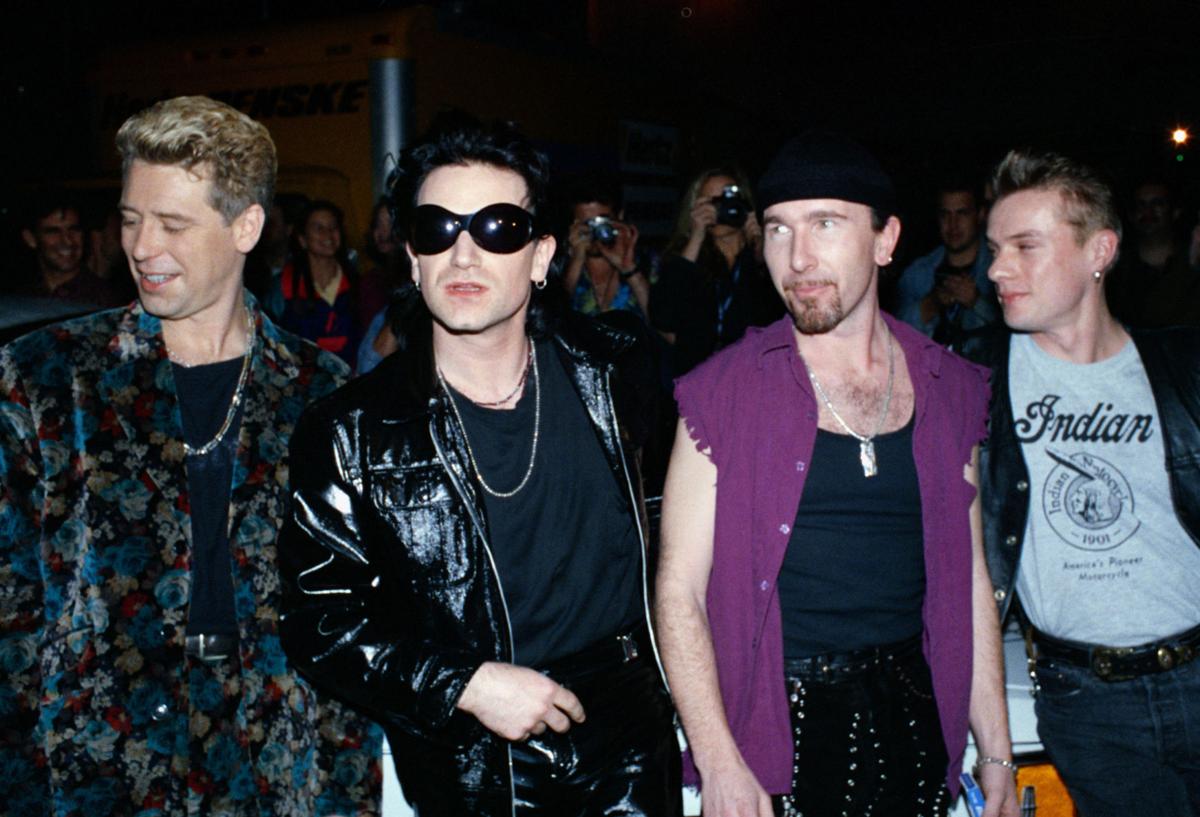
Whether you think “One” is about love, or about the fall of the Berlin Wall, or the yet other inspiration that it was a comment by Bono about the “peace and love” movements of the sixties, it speaks a lot to the song’s power that it can gain considerable meaning from multiple viewpoints. It works as a breakup song because of the acknowledgement that both the man and the woman are pulling apart from each other, with the positive moments between the couple serving as a distraction from the main thrust. It works as a commentary on the hippie aesthetic, since the “one love, but we’re not the same” exposes the lack of specificity in its philosophy. And of course, it’s a powerful statement on the dawning of a new era. It helps, of course too, that the music is gorgeous.
U2, for how popular they are, are a great band with one big problem in their eighties material. Their songs just all sound the same. Listen to “With Or Without You” and “Where The Streets Have No Name” again. Both songs are built around the same chords. No band have ever lucked out so much for being so lazy. Songs with laughable lyrics and pathetic instrumentation that somehow become #1 hits don’t count. So a new chord progression was desperately needed when U2 came back in 1992. But now, gone are the ringing guitars and arpeggios, to be replaced by The Edge’s watery guitars surrounding his standard acoustic guitar. While U2’s previous hits all sounded like they were searching for the truth, here the sound becomes much more mystical, much more atmospheric. Producer Brian Eno’s keyboards may be the unsung hero of the track, making the song sound way more uplifting than it has any right to be. Which is quite odd, since Eno initially hated the track and demanded that the band deconstruct it for the right to include it on Achtung Baby. So based on what I’m gaining from his insight, it had to be a breakup track that sounded happy? I guess. But it adds to the whole commentary on the reunification/hippie aesthetic interpretation of the lyrics: maybe one day we will be able to achieve nationwide peace.
I’ve been rambling on about “One” because I don’t know what to say about it other than that it’s a great song that revived U2’s career at a time when their careers were in jeopardy. In a year where grunge and indie music were taking over and eighties bands were dropping like flies, U2 easily could have joined the declining bands. But they took a bold new step with a song that accumulates many meanings, many moods. Some would say that “One” is one of the most heartbreaking breakup songs ever made. Others may say it’s about the uncertainty that faced the world after the end of the Cold War. But either way, it’s a song that leaves you enraptured for its 4 ½ minute length.
UP NEXT: A legendary band’s signature song at #2.
SOURCES
McCormick, Neil. U2 by U2. London: HarperCollins, 2006. Web. 28 August 2022. Information gathered from Wikipedia: https://en.wikipedia.org/wiki/One_(U2_song).
Chords taken from Ultimate Guitar: https://tabs.ultimate-guitar.com/tab/u2/one-chords-777336.
“One by U2.” Songfacts 2022. Web. 28 August 2022 https://www.songfacts.com/facts/u2/one.
Chords for “With Or Without You” and “Where The Streets Have No Name” taken from Ultimate Guitar:
https://tabs.ultimate-guitar.com/tab/u2/with-or-without-you-chords-835
https://tabs.ultimate-guitar.com/tab/u2/where-the-streets-have-no-name-chords-704016.
Stokes, Niall. U2: Into The Heart: The Stories Behind Every Song. New York City: Thunder’s Mouth Press, 2005. Web. 28 August 2022. Information gathered from Wikipedia: https://en.wikipedia.org/wiki/One_(U2_song)
IMAGE SOURCES
Single cover from eBay
Photo of U2 from Madison.com


Leave a comment