Probably the biggest reason why 1992 stands out as a good year for rock and alternative is not the songs that hit it big in 1992, but the songs that weren’t on the charts. Some of these songs were highly influential in rock music history, while others are longtime personal favorites of mine. Some of these songs you may not know, but others will leave you asking, “This wasn’t a chart success?” Let’s start off with a song you probably didn’t recognize heading into this list, but is a personal favorite of mine.

“Sunshine Smile” – Adorable
Modern Rock
#29 peak (June 26, 1993), 1 week on chart
Eligible for 1992 due to initial release in UK
If you don’t know Adorable… that’s okay. One of several British shoegazing bands to receive a chance at relevance after My Bloody Valentine and Loveless, Adorable is notable for two main reasons. The first being their more melody and lyric-driven songwriting in a subgenre known for cryptic lyrics, and the second being their overly confident attitude about themselves, serving as a warm-up for Oasis later that decade. But they have one song that deserves all the attention in the world, and that is their debut single “Sunshine Smile.”
On the surface, “Sunshine Smile” is your typical song about unrequited love. What truly sets this song apart and makes it one of the best rock songs of the year is the music. Bassist Stephen Williams’s bassline is sharp and concise, while Kevin Gritton effortlessly switches from tapping his cymbals in the verses to his thunderous stabs at the beginning of each chorus, evidently as an answer to “Smells Like Teen Spirit.” But then we get to the shimmering guitar parts. Guitarist Robert Dillam’s lead guitar lazily glides in the first verse between A and A flat, with the effects pedals making even the simplest patterns sound heavenly and inviting. Then in the chorus, Dillam and frontman Pete Fijalkowski’s D and G chords are so visceral, so otherworldly, that they add a completely new dimension to the loud-quiet formula that was about to get beaten to death in the wake of Nirvana. It is now about the cascading wall of sound, and how something so loud can be so beautiful – a major strength of shoegazing that was to be forgotten after the nineties ended. Add to that the song’s outro, when Dillam’s beautiful and stunning arpeggiated guitar chords mesh with Fijalkowski’s guitar freakout between E flat and E, and the music delivers its message of love in a way the lyrics can’t. “How does it feel to feel,” indeed.
“Sunshine Smile” is easily the most obscure song I’ve highlighted on this segment so far. Until recently, “Sunshine Smile” wasn’t available on Spotify before being added as part of a 90’s compilation, and while the song’s second video is on YouTube, you still have to wander over to Vimeo to watch the primary vid. It’s a shame because Adorable and their debut album Against Perfection is worth checking out: the violent guitar chords clashing with Fijalkowski’s orgasmic moans on “Favorite Fallen Idol,” more beautiful lead guitar work on “A To Fade In,” and “Homeboy,” one of the few overly sentimental love songs that doesn’t make me gag. But “Sunshine Smile” is by far their best work, and deserves way more attention from American music fans in particular. It’s five minutes of pure escapist fantasy.
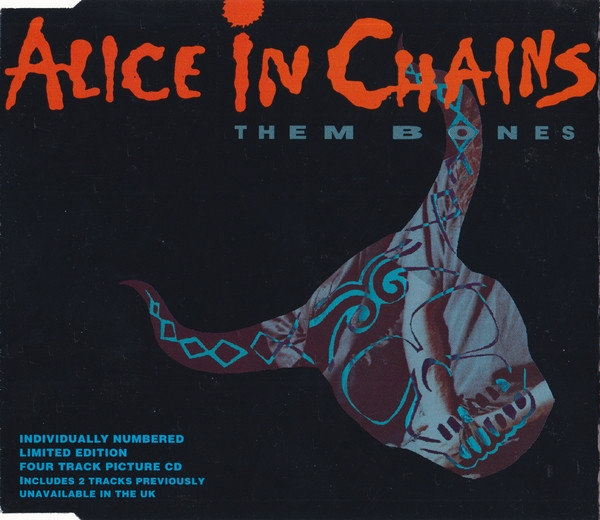
“Them Bones” – Alice In Chains
Modern Rock
#30 peak (November 28, 1992), 1 week on chart
Mainstream Rock
#24 peak (November 21, 1992), 9 weeks on chart (7 in 1992)
UK
#26 peak (March 20, 1993), 3 weeks on chart
Well, this was an easy pick. Alice In Chains consolidated position as one of the big four with “Them Bones,” the opening track to their seminal album Dirt. Alice In Chains was known as the band where you could see the beauty masked against the ugliness, but they were going one level darker on this song, a song that reminds everyone that one day, death is inevitable.
First off, that riff. Jerry Cantrell never quite topped the opening riff to “Man In The Box,” but man did he try. Other than “Money” by Pink Floyd and a song that is coming later on this list, has there ever been a better song written in 7/4 time? Cantrell’s riff, going from the drop C# tonic to D#, E, and F#, is just so sludgy and thunderous, as if it’s signaling the impending doom of a sledgehammer smashing our heads. Then there’s his guitar solo, beginning with simple hammer-ons from the A flat string and slowly slashing to the top of the fretboard. Alice In Chains was the darkest of the big four grunge groups, and “Them Bones” is them living up to their billing not just musically, but lyrically.
Toll due, bad dream come true
I lie dead gone under red sky
While the best grunge vocalist by far was Chris Cornell, I think Layne Staley was my personal favorite of the group. Every song, you can hear him baring his soul. “Them Bones” has him playing the role of the gatekeeper, the one who is there warning us all of the impending doom we must face. It makes it harder to hear today, since it was only downhill from here for Staley until his death from a drug overdose in 2002. But it also makes “Them Bones” more powerful, as he made a song written by someone else sound so personal, as if it was all happening to him. “Them Bones” is a gothic grunge tour de force.
“What Are We Gonna Do” – Dramarama
Modern Rock
#10 peak (January 25, 1992)
#95 year-end, 8 weeks on chart
There was a crowded field of nominees when I was putting together the list of the best rock songs that weren’t successful in their initial release. But in a field that included Blur, Megadeth, and Nine Inch Nails among others, this band you’ve probably never heard of snuck through and nabbed the final slot. It surprised me for sure, as I hadn’t heard this song until I did preliminary research for 1992 due to its minor chart success. So how did Dramarama and “What Are We Gonna Do” make the cut?
Well, to start off, the composition is great. Bermont Tench’s opening A and A7 piano chords have all the precision of a music box. Adding to that, while the chorus consists of nothing more than the song’s title, but it’s a great chorus with how all the instruments, from the guitars to the keyboards and the drums, come together to a climax. But the element that got “What Are We Gonna Do” on the list is simple: the opening line. In just a few months, it’s become one of my favorite opening lines to a song ever.
It’s April 21st
And everybody knows today is Earth Day
Merry Christmas
Happy Birthday to whoever’s being born
For those of you who don’t remember your mandatory Earth Day celebrations in Elementary School (let’s be honest, no one remembers them), April 21st is not Earth Day. It comes one day later, on April 22nd. And it is most definitely not Christmas Day. But as for the last line, why thank you Dramarama! You’re the only band on this list who wished me a happy birthday! But with this line, Dramarama helped to found the beginning of the postmodern irony that would define the nineties. The whole misleading line about Earth Day has to be deliberate, taking a small error that would slip past most people’s heads and expanding it into a line that makes zero sense. Dramarama was one of the bands representing the old guard by 1992, having been founded in 1981 and having released their first album in 1985. But they apparently had a premonition about the oncoming wave of grunge. The opening line to “What Are We Gonna Do” proves that Dramarama was savvier than the other bands of their ilk, taking the weirdness of the eighties and merging it with the caustic realism of the nineties.
And the rest of the lyrics are similarly oblique: the second verse goes into detail about the world ending in 2041, and how frontman John Easdale can’t come up with a proper message to explain all this. “What Are We Gonna Do” is the anthem for the rebel without a cause, one who was unable to find a way to project his message without playing mind tricks on others. And with that, I’ll make sure my 48th or 49th birthday is a blast.

“Fifteen Years” – Levellers
UK
#11 peak (May 23, 1992)
#74 year-end, 5 weeks on chart
In the world before Parklife and Oasis, Britain became a wild land featuring tons of subgenres that never quite gained a hold in America: the fading embers of Madchester and Baggy, the neo-psychedelia of Shoegazing, the beginnings of Trip Hop and Big Beat, and the continuation of punk rock. But also among these subgenres was the resurgence of folk rock and celtic music throughout the islands. While most bands from this genre did not receive mainstream success, one band that did receive popularity was The Levellers, who achieved eight top 20 singles in the UK without a single one going into the top ten. In May 1992, they scored their breakthrough single “Fifteen Years,” a song that turns a dour and sad tale of a wasted man into a Tolkien-esque fantasy.
As a folk band, The Levellers used several instruments unusual in rock music, with Simon Friend playing mandolin and the banjo while Jonathan Sevink played fiddle alongside the basic guitar-bass-drums setup. And boy did it work here. Friend’s opening staccato mandolin riff, coupled with Sevink’s majestic fiddle playing throughout the song where he acts as the lead instrument, provides the escapism that recalls the landscapes of Middle Earth or Narnia, rather than the mundane bar the song really takes place in. Adding to the soundscape is frontman Mark Chadwick’s rhythm guitar, which provides a rhythm with its A5 and G5 chords that is so steady and aggressive that most rock bands would be jealous.
All this is juxtaposed with a tale of a pathetic alcoholic, who has become completely consumed by his vices. He has lost the love of his life, and is now stuck with a dead-end job and a presumably lousy apartment, run by a landlord who sounds like another fantasy figure in The Levellers’s world. It’s a song where fantasy completely overtakes reality, for both the protagonist and ourselves.

“Wherever I May Roam” – Metallica
Pop
#82 peak (August 8, 1992), 7 weeks on chart
Mainstream Rock
#25 peak (August 29, September 19-October 3, 1992)
#85 year-end, 16 weeks on chart
UK
#25 peak (November 7, 1992), 4 weeks on chart
Let’s end the debate now: Metallica did not sell out when they joined forces with Bob Rock for their 1991 self-titled album. For one, Metallica was still very much a metal band, with riffs and angry attitude to spare. Just not as many long songs or complex guitar parts. Second, and most importantly, Metallica filled the album with classic song after classic song, from the opener “Enter Sandman” (which I will be talking about in 1991), “Sad But True,” and the thrashing, pummeling “Wherever I May Roam.”
It’s been said that James Hetfield is a terrible lyricist. But do you care? His message in “Wherever I May Roam” of conquering everything that lies in his path is just so perfect for his band that I find nothing to complain about. And then there’s his voice, which just rages with alarming intensity. But then there’s the main reason this song got nominated: that pounding riff. The opening sitar riff immediately creates an unsettling, otherworldly atmosphere to the song, and then once Lars Ulrich’s drums kick in full force 47 seconds into the song, it’s all business. The main riff, alternating between Kirk Hammett’s simple but effective three note riffs and Hetfield’s crushing A-A#-B-C riff sounds like it could crush everything in its path. And just when it seems that the simple riff to this song, plus the overly simple main riff to “Nothing Else Matters” implied that he couldn’t play anymore, Hammett finishes the song with numerous snake charmer solos in the fade out. Metallica may have “sold out” as it were, but they still knew how to thrash. “Wherever I May Roam” fits the bill in spades.

“Only Shallow” – My Bloody Valentine
Modern Rock
#27 peak (February 1, 1992), 2 weeks on chart
One of the most important albums of the entire decade, not just in Europe but throughout the entire world, was My Bloody Valentine’s 1991 masterwork Loveless. For all the infamy about its troubled and delayed production, along with Kevin Shields’s disappearance from the music industry for the following two decades, Loveless is not just the most famous shoegazing album, but the album that spawned a new generation of psychedelic rockers, right up to the present day. As luck would have it, the album’s only official single didn’t come out until 1992. While not the best song on the album, “Only Shallow” is the song that lays the groundwork for Loveless and its main appeal: an album that sounds so distorted on the surface but in actuality is so beautiful.
It all starts with Kevin Shields’s guitar playing. In a genre where guitarists were constantly looking to play their instruments in ways that had never been done before, “Only Shallow” was written in Gm a modal tuning. Shields’s gliding guitar playing while waving his tremolo bar is instrumental in creating the song’s dreamlike atmosphere, with the sampler and Yamaha SPX 90 effect pedal working together to create a ghostly effect on the song’s main riff. And then there are the vocals. Instead of Shields, Bilinda Butcher sings this one for My Bloody Valentine. But it was the right call here, because her voice just adds to the comforting feeling of the song and its lyrics. In Shoegazing and My Bloody Valentine especially, lyrics were secondary with how difficult it often was to make out the vocals; I often joke that it’s an entire subgenre based on R.E.M.’s Murmur. But Butcher’s voice is so comforting, as if she’s the one calming force amidst the forces of chaos that come from Shields’s guitars. When Bilinda sings “sleep like a pillow” and “look in the mirror,” she enters the room to tell you that everything will be okay, and nothing will hurt you regardless of circumstance.
“Only Shallow” isn’t even the best song on Loveless, as the album also houses “Sometimes,” a song that is indescribably beautiful despite its grimy surface. But for a band introducing themselves to much of the world, “Only Shallow” wasn’t a bad way to start, and serves as the scene-setter for the magical experience that was to follow.
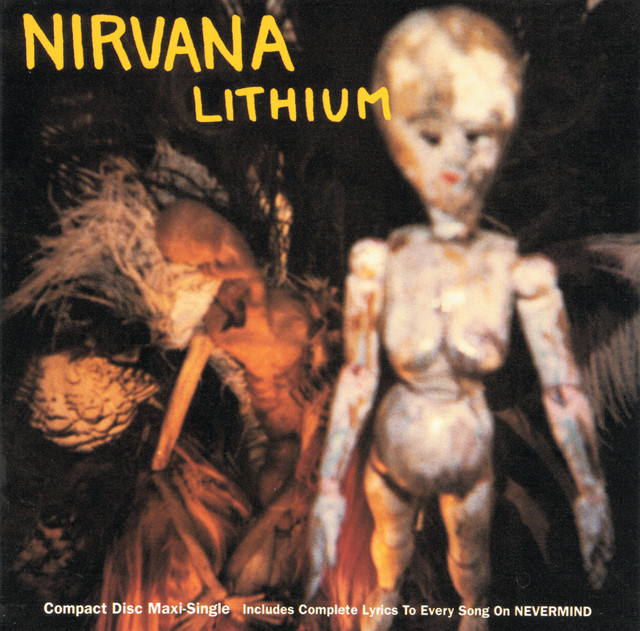
“Lithium” – Nirvana
Pop
#64 peak (August 15, 1992), 9 weeks on chart
Modern Rock
#25 peak (February 8, 1992), 3 weeks on chart
Mainstream Rock
#16 peak (July 25, 1992)
#77 year-end, 16 weeks on chart
UK
#11 peak (August 1, 1992)
#54 year-end, 6 weeks on chart
Usually when I pick out the sins of omission, I’m going for the songs that I like the most, regardless of professional opinion. But with “Lithium,” it felt like my duty to put this song on the sins of omission. I mean, think about it. This song, the third single from the biggest alternative music album of all time, wasn’t big enough to make the top 75 of either the Mainstream Rock or Modern Rock year-end lists? I could have very easily put “On A Plain” on here, as it was also released as a single in 1992 and honestly may be a song I prefer. But doing 1992 and not including “Lithium” just felt so wrong. So let’s just recite information that we already know: as with every song on Nevermind, “Lithium” is great.
While The Pixies were the pioneers of the quiet/loud verse/chorus formula, Nirvana was the band that turned it into a cliche. But even more so than “Smells Like Teen Spirit,” “Lithium” is probably the biggest example of the formula on the record. The verses, with its G5-F#5-B5-G5 opening riff alternating between power chords and arpeggiated chords, are just sitting there, waiting to detonate when the distortion and Dave Grohl’s drums kick in. But what is particularly interesting in regards to “Lithium” is not the music, but the lyrics.
Many have interpreted “Lithium” as a song critical of religion, as Cobain notably was raised by his religious relatives for part of his childhood. However, Cobain went on record to say that the song was about depression, and that the man in the song turns to religion as a last-ditch effort to stay sane. And I’d agree with Cobain here, it’s a song where the narrator appears to be fluctuating wildly between happiness and insanity.
I’m so lonely, that’s okay, I shaved my head
And I’m not sad
And just maybe I’m to blame for all I’ve heard
But I’m not sure
He takes his shortcomings so casually that it is becoming clear that religion is not helping him overcome his struggles. Not to mention this song features two of my favorite Nirvana lyrics, which just further show Cobain’s twisted sense of humor:
I’m so ugly, that’s okay, ’cause so are you
I’m so horny, that’s okay
My will is good
Kurt Cobain was one of those songwriters who could seemingly do no wrong, where two seemingly juvenile detours in the writing still do not detract from the song’s unsettling experience. “Lithium” remains a classic, as if I needed to tell anyone. And seriously, this song didn’t qualify for my year-end list? I cannot get over that.

“Twisterella” – Ride
Modern Rock
#12 peak (June 27, 1992)
#90 year-end, 8 weeks on chart
UK
#36 peak (April 25, 1992), 2 weeks on chart
Simply put, shoegazing was a genre that was more about influence and expanding the boundaries of music than commercial success. The dreamy guitars, the vague lyrics, and the faded vocals were a giveaway that this was not a genre where you expected to release a song and have it become as big as “I Will Always Love You.” But if there was ever a song that proved that shoegazing deserved hit records, it was “Twisterella,” a maddeningly catchy and beautiful song. And again, I am mystified that both America and Britain couldn’t find space for this song to become a chart success.
Ride were a shoegazing band from Oxford notable for having two songwriters who split the glory. While guitarist Andy Bell became by far the more successful and better known of the two due to his later success in the Britpop era with Hurricane #1 and especially in the 2000’s with the second era of Oasis, it is frontman Mark Gardener who takes center stage on this song. And just like their band name, Gardener’s lead vocals just ride the wave of the dense guitars and steady drumbeat. As if he needed to present shoegazing in a digestible package to the mainstream, Gardener’s lyrics play an old trick: it’s a happy song about drugs.
Feel the weight of letting go
Feel more lightness than you’ve ever known
You can’t see when light`s so strong
You can’t see when light is gone
But the previous statement about this being Gardener’s song is only partially correct. The moment the song kicks in, Andy Bell steals the song outright with a bright, jaunty guitar riff that is embarrassingly catchy and is way too sunny to remove from the senses. If there were ever a shoegazing riff you could sing along to, this is it. Adding to that, Bell adds the perfect A-A flat-E descending backing vocals to Gardener in the chorus when he sings, “Why’s this bus taking me back again?” But not only does Bell’s guitar work stand out on “Twisterella,” but bassist Steve Queralt’s opening bass run is thick and sharp. Seriously, I was into this song during my British 90s phase, so why now is it taking me back again?
UP NEXT: The final two sins of omission are so great in stature that they deserve the full treatment. Let’s start in Britain.
MORE GREAT 1992 SONGS
A list of other great rock and alternative songs from 1992 that weren’t eligible for this countdown:
“I’ll Be Your Saint” – Adorable
“Would?” – Alice In Chains
“Popscene” – Blur
“Tremolo Song” – Charlatans
“Horror Head” – Curve
“Winona” – Drop Nineteens
“Disappointed” – Electronic
“Steamroller” – The Family Cat
“Unsung” – Helmet
“Dragging Me Down” – Inspiral Carpets
“Shivering Sand” – Mega City Four
“Symphony Of Destruction” – Megadeth
“Happiness In Slavery” – Nine Inch Nails
“On A Plain” – Nirvana
“Trigger Cut Plus 2” – Pavement
“Anybody Listening?” – Queensryche
“Feel The Pain” – The Real People
“Join Our Club” – Saint Etienne
“Boss Drum” – The Shamen
“Rusty Cage” – Soundgarden
“Medication” – Spiritualized
“Waterfall” – The Stone Roses
“Crackerman” – Stone Temple Pilots
“A Good Idea” – Sugar
“Stupid Kid” – Sultans Of Ping FC
“What You Do To Me” – Teenage Fanclub
“She’s A Superstar” – The Verve
SOURCES
Chords for “What Are We Gonna Do?” from Ultimate Guitar: https://tabs.ultimate-guitar.com/tab/dramarama/what-are-we-gonna-do-chords-3547790.
Information on the tuning for “Only Shallow” gathered from Wikipedia. If I am wrong, please blame them.
DiPerna, Alan. (1992). “Bloody Guy”. Guitar World March 1992. Pg. 26–152. 21 August 2022. Information gathered from Wikipedia: https://en.wikipedia.org/wiki/Only_Shallow.
Cobain, Kurt. “Nirvana ‘Lithium’ Sheet Music in E Major – Download and Print.” MusicNotes.com 2022. Web. 21 August 2022 https://www.musicnotes.com/sheetmusic/mtd.asp?ppn=MN0067119.
Azerrad, Michael. Come As You Are: The Story Of Nirvana. New York City: Doubleday, 1994. Pg. 218. 21 August 2022. Information gathered from Wikipedia: https://en.wikipedia.org/wiki/Lithium_(Nirvana_song)#cite_note-Azerrad218-23.
I pieced together that “Twisterella” was about drugs after I read the responses to the lyrics here: https://songmeanings.com/songs/view/135362/.
IMAGE SOURCES
“Sunshine Smile,” “Them Bones,” and “Fifteen Years” single covers from Discogs
Vinyl album cover from eBay
“Wherever I May Roam” single cover from Amazon
“Only Shallow” single cover from Genius
“Lithium” single cover from Spotify
“Twisterella” single cover from RIDE Archives


Leave a comment