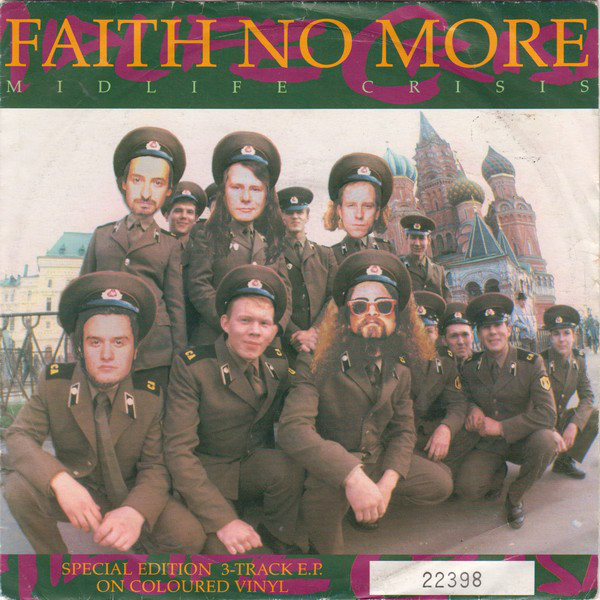
“Midlife Crisis” – Faith No More
Modern Rock
#1 peak (August 8, 1992)
#20 year-end, 12 weeks on chart
Mainstream Rock
#32 peak (August 15, 1992), 5 weeks on chart
UK
#10 peak (June 6, 1992)
#82 year-end, 5 weeks on chart
The origins of my music criticism career began several years ago, when I created a massive 200 song list on Spotify consisting of every one hit wonder I could think of, which I began listening to at the same time I picked up Todd In The Shadows and his One Hit Wonderland series. One of the songs I included on said list was “Epic” by Faith No More. I knew they had other songs, like “Evidence” and “Last Cup Of Sorrow,” but I figured they didn’t count because I only learned of them through The Chart Show and had never heard them on radio. Over the last few years, I’ve slowly but surely been removing Faith No More from the One Hit Wonder list. Which brings us to “Midlife Crisis,” which may now be my favorite Faith No More song.
The first thing to know about “Midlife Crisis” is that it absolutely should not work. For one, it is an alternative metal song that isn’t really that heavy. With its string section and lack of lead guitar, it comes across with little in common with Black Sabbath. Second, frontman Mike Patton regularly splits between angrily rapping and majestically signing. And now you’re likely asking how on earth this song was one of the best rock songs of the year.
I think the main reason why I ended up loving this song is how majestic the song is despite its diverse construction. After Billy Gould’s bumping, descending hip hop bass pattern powers the verses, you’re probably getting the impression that this is going to be a dour, plodding song. But then in the chorus, Jim Martin’s guitar and Roddy Bottum’s keyboards create an ethereal, soaring sound with its E-D-A chord progression. Bottum really stands out in the bridge, where his keyboards soar in a way most keyboard parts fail. For the longest time, I thought the band hired a string section for this part. But no, it’s the synth. He really did an amazing job turning a song about paranoia in celebrity culture sound so uplifting. And of course, credit goes to frontman Mike Patton. The man who was rated the greatest rock singer of all time based on vocal range by Vintage Vinyl News (6 octaves) pulls off a performance few could have matched. So much of the song is Patton switching from rapping and shouting to singing, and he pulls it off so effortlessly, rising from the lowest octaves in his range. “Midlife Crisis” is further proof that there is more to Faith No More than “Epic.”
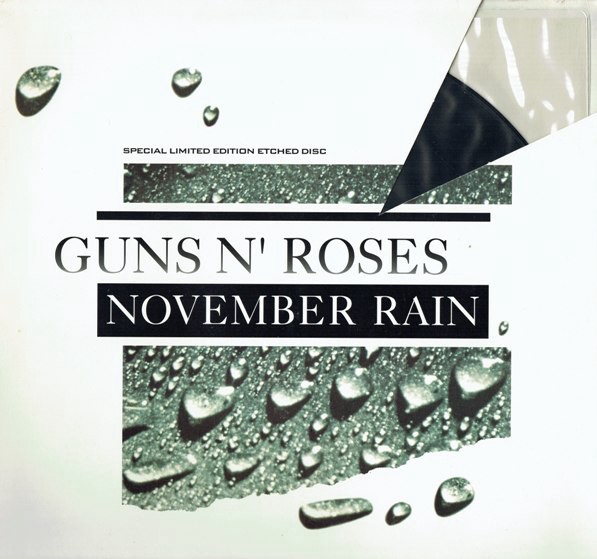
“November Rain” – Guns N’ Roses
Pop
#3 peak (August 29, 1992-September 5, 1992)
#17 year-end, 20 weeks on chart
Mainstream Rock
#15 peak (January 11-18, 1992)
#62 year-end, 26 weeks on chart (17 in 1992)
UK
#4 peak (March 7, 1992)
#56 year-end, 5 weeks on chart
Yep. The most critically acclaimed song of 1992 outside of “Smells Like Teen Spirit” in any genre didn’t make the best list. But I need to make it clear that I do like this song. I do know enough about music to know that it is very good. And the reason it is not on the best list is simply because I found ten songs that I would rather listen to. What can I say, it’s the nineties, and the nineties was such a great period for rock music.
I really don’t know what to put down here that hasn’t been said before about “November Rain,” since it’s one of those rock songs that everyone loves. I guess the only true thing I can bring up here is that during the main part of the song, which lasts for the first 6:45 before the final “Everybody needs somebody” act takes place, it was actually the lesser-discussed parts that impressed me the most. Well, except for Slash’s first solo. That soaring riff that centers around the A flat note he plays in front of the chapel is iconic. Use that set in the desert for every great rock solo. But it isn’t really the verses or the “cold November rain” chorus that get to me. It’s the pre-chorus and bridge about overcoming lost love.
Everybody needs some time on their own
Don’t you know you need some time all alone
While the chorus and the solo get all the attention, it is this part that sets the table for the heartbreaking finale. As a song that ends in heartbreak and a music video that ends in death, this is the line that foreshadows everything. A couple very much in love is planning on spending time apart to find out whether or not they are in fact true love, at which point they learn they are not meant to be, setting in motion the final act.
While the bridge stole the show for me when I finally heard the song in full for this list, it is of course the ending that explains why this song nearly saved itself from missing the top ten. The transition from the song’s B major key to its B minor key and the arrival of Slash’s ominous B minor chords at the 7 minute mark give me chills. Now this is how you execute a key change: taking a song and turning it into something else entirely, completely changing the song’s mood and progression. So many key changes fail because they are nothing more than weak attempts at adding drama to a song, but “November Rain” brings the drama by tying together the lyrical themes that have been progressing in the main segment of the song, coupled with Axl Rose’s powerhouse vocals and Slash’s incredible skyward guitar solo. “November Rain” has become one of the best known rock songs of all time, and now I know why.

“For Love” – Lush
Modern Rock
#9 peak (March 7-28, 1992)
#49 year-end, 12 weeks on chart
UK
#35 peak (January 11, 1992), 2 weeks on chart
During the time I was working on this column, Halloween passed us by. And there was no song I heard this past year that was more fitting for Halloween than this song. I was aware that Lush was a shoegaze band before they went Britpop, but who would have guessed the band who became best known for the badass tell-off single “Ladykillers” had their other notable song be a haunting, vanishing dream, the type that would only be appropriate for Halloween?
The best way to describe “For Love” is that it is an enigma. It’s a song about an enigmatic love interest who is likely setting up a smokescreen as a beautiful girl and instead presenting herself as a toxic presence in a man’s life. But for being a song about a doomed couple, it is so beautiful. Shoegazing had a talent for making everything sound so beautiful and ugly at the same time, and while they were more middle of the road than My Bloody Valentine, Lush proved they were than capable of emphasizing the genre’s many moods. For being a song about love, it truly doesn’t sound like it, as the haunting opening E and C chords sound as if they’re coming from a haunted forest. The overall sonic landscape of the song, with the minor chords coupled with Miki Berenyi’s ghostly voice, are the overall sonic representation of a ghost chasing you on Halloween as you’re going out for candy.
And yet, at the same time, the song sounds so beautiful, so comforting. As spooky as “For Love” sounds (funny that Lush named the song’s parent album that), the song also resembles a happy dream, a dream about the best, most adventurous Halloween that never was. Berenyi’s vocals and Emma Anderson’s lead guitar riff in the bridge and outro sound like our guiding lights, our signals out of the darkness. While virtually everyone knows “November Rain,” “For Love” is a hidden gem to both Americans who don’t know the band, and Brits who best know Lush for their Britpop phase.

“Movin’ On Up” – Primal Scream
Modern Rock
#2 peak (November 23, 1991)
#46 year-end, 16 weeks on chart (9 in 1992)
Mainstream Rock
#46 peak (December 14-28, 1991), 7 weeks on chart
UK (as Dixie Narco EP)
#11 peak (February 15, 1992)
#61 year-end, 6 weeks on chart
One of the odd things with Britpop is that there was no consistency with who was regarded as Britpop, or not Britpop. Just because you were retro in your sound or you were copying the playbook of your favorite bands from your childhood did not necessarily mean you were Britpop. Take Primal Scream, one of the biggest British indie rock bands of the decade. Although they often showed just as much influence to the Rolling Stones and the first wave of psychedelia as the Charlatans, they were able to escape the dreaded label British musicians did not want to hear. My guess is it was because while other bands were chasing trends with their Britpop songs, Primal Scream were in their own little world, consistently changing their sonic palette on each album. Probably the closest they got to Britpop was on their much-maligned 1994 album Give Out But Don’t Give Up, an album that paid a considerable debt to The Rolling Stones. But Primal Scream first mined the Rolling Stones for material on the introductory track to their 1991 album Screamadelica, which became their only song to become successful on the US Modern Rock charts.
For being the leadoff track to an album that combined rock music with the fledgling electronic scene, I’m surprised this song fit in at all. It sounds, more than anything, as a lost B-side to “You Can’t Always Get What You Want.” Everything is there: the dangling acoustic guitar, the emphatic vocal performance, and especially the gospel choir. And then you find out that the song was produced by “Mister” Jimmy Miller and the whole thing starts to make sense. For how much I’ve been comparing this song to The Rolling Stones though, “Movin’ On Up” is still a fabulous song that uses its material as an inspiration, rather than as a crutch.
How does it work so well? Well, there are so many intriguing musical elements in the song that stand out. Phillip “Toby” Tomanov’s bongos are just popping throughout the entire song and add another dimension to the song’s retro sound. Adding to it are Martin Duffy’s descending piano pattern, Robert Young’s bluesy guitar riffs in the second half, and of course Bobby Gilespie’s soulful vocals. But best of all is that choir. They may be such an obvious reference to The Rolling Stones, but then you hear the way they ascend from E to F on the “Our light shines on” and it becomes a song that can stand on its own two legs. We’re no longer hearing Rolling Stones rip off artists, we’re hearing gospel rock: a song that becomes just as joyous and happy as a song played in an actual church choir. And a song that proves that Primal Scream deserved way more success in America than they ever had.
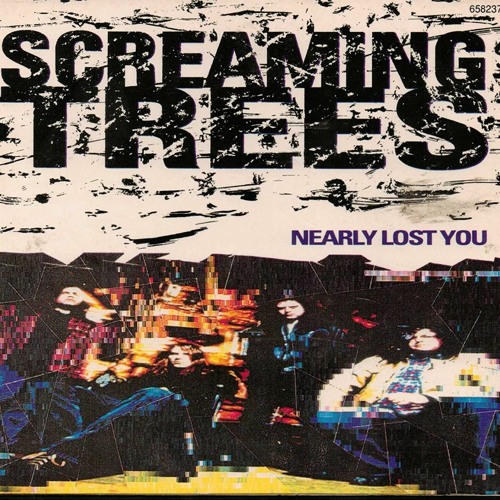
“Nearly Lost You” – Screaming Trees
Modern Rock
#5 peak (October 31-November 7, 1992)
#36 year-end, 19 weeks on chart (13 in 1992)
In a crowded field of contenders, this was the last song to make the top 20. Quick shoutout to “Somebody To Shove” by Soul Asylum, which engaged this song in a fight to the death for who would take the final slot on this segment. Honestly, I could have just decided the final slot on a coin flip, but “Nearly Lost You” just felt a razor-thin smidge more unique, more attention-grabbing. And it all comes back to the Screaming Trees’s darker, more twisted form of grunge.
The entire song sounds very demented, very unsettling, yet very fulfilling at the same time. Gary Lee Conner’s distorted guitar chords go from triumphant to foreboding at the same time, while the song itself is about drugs and how they can cause you to fall into insanity for a brief moment before suddenly, you’re brought back to the present:
Drag me far enough to know
I’m blind every mile that you burn
There’s a rider that’s fallen and
It’s clear there’s no time to return
But of course, the most unsettling and unique aspect of “Nearly Lost You” is frontman Mark Lanegan’s gravelly voice. He may not be as well known as Cobain or Vedder, but he was one of the most engaging vocal personalities of the grunge era. Those of you who probably know him best these days for his stint in Queens Of The Stone Age and songs like “Song For The Dead” and “In The Fade” are aware that this man is an enigmatic performer. His leathery voice is so ragged yet so smooth at the same time, with how he transitions from the gravelly, deep verses to the surprising highs he reaches in the chorus. He may have eventually disowned the track, but “Nearly Lost You” is a testament to Lanegan as one of the most dynamic vocal talents of his generation.

“Ebeneezer Goode” – Shamen
UK
#1 peak (September 19 – October 10, 1992)
#6 year-end, 10 weeks on chart
As unlikely as it may be, this was my final cut from the best list. For a time, I had it as my number nine entry, until I realized that I actually do love “Friday I’m In Love” and came to the understanding that I would have been causing mood whiplash by putting in a rave track in the middle of a rock music list. But as a member of the indie label One Little Indian, The Shamen qualify as Alternative. And with their biggest hit “Ebeneezer Goode,” The Shamen wrote the ultimate embarrassing dance anthem, a song endorsing the use of drugs that merely causes throngs of people to jump up and dance.
Before we get into why this song is so amazing, we need to address the elephant in the room. The “Ebeneezer” in the song is a reference to ecstasy, which was reaching a fever pitch in the Madchester and rave culture that was springing up in Britain at the turn of the decade. Dancers took MDMA to effectively lose all connection with the world as they took in the music, Damon Albarn acted like an absolute raving lunatic after taking the drug before Blur’s debut appearance on Top Of The Pops, and Will Ferrell went insane after eating his first bowl of Cracklin Oat Flakes with ecstasy. Sorry, bad example. As if the example isn’t hitting you in the head easily enough, Ebeneezer is constantly referred to as “Eezer,” as exemplified in the chorus:
‘Eezer Goode ‘Eezer Goode He’s Ebeneezer Goode
‘Eezer Goode ‘Eezer Goode He’s Ebeneezer Goode
Eezer Goode. As in, “E’s are good.” Take ecstasy, it’s good for you. Keep in mind, too, that this is the band whose greatest song, “Re-Evolution,” was performed by Timothy Leary advocate Terence McKenna and promoted the use of LSD and psychedelic drugs in order to “dissolve boundaries.” So how does this song work? Simple: It’s so danceable!
If you can’t dance to the insane rave groove The Shamen put down on “Ebeneezer Goode,” you’re not human. Richard Sharpe and Mr. C’s keyboards are constantly pulsing, and the high-pitched synth riff that eventually is equaled in the chorus is insanely catchy. Speaking of which, Mr. C’s vocal performance is cartoonish in the best way possible, he’s the guy who’s jumping up and down with a court jester hat and not aware of the embarrassment he’s enduring, whether it’s his frenetic rapping in the verses or his nasal “Naughty! Naughty! Very naughty!” The entire song becomes a test to avoid dancing to a song endorsing drug use, which you are destined to fail. Additionally, if you are still objecting to the song’s subject matter, the song is calling for recreational drug use, not drug addiction:
A gentleman of leisure he’s there for your pleasure
But go easy on old ‘Ezeer he’s the love you could lose
Extraordinary fellow, like Mr Punchinello
He’s the kind of geezer who must never be abused
Bet all the old, cranky music critics who attacked the song missed that.
“Bad Luck” – Social Distortion
Modern Rock
#2 peak (February 22-March 14, 1992)
#19 year-end, 12 weeks on chart
Mainstream Rock
#44 peak (April 18, 1992), 5 weeks on chart
Every year, I need to have one of these freebies. A song that was clearly written less for lyrical introspection and more for brainless rocking out. For a year where bands like U2 and Pearl Jam were pushing the dial and changing what rock meant for people, it feels so weird to put a song this simple on the list. But that’s part of its charm. “Bad Luck” may not be as famous or as deep as “Under The Bridge,” but every time I heard the song while going through 1992, I always wanted to jump up and down regardless of whether or not I was in my car (which I usually was while listening to the eligible songs).
I shouldn’t completely discount the meaning of the song, but the meaning of the song is blatantly obvious. It’s about a pathetic loser who always draws the short end of the stick.
Some people like to gamble,
But you, you always lose.
Some people like to rock ‘n’ roll,
You’re always singin’ the blues
Furthermore, the song’s chorus consists solely of the line, “You’ve got bad, bad luck,” which as I’ve already gone over is usually a turnoff of mine. And finally, the song consists of just three chords: F#, C#, and G#, which never changes in the song’s 4 ½ minute runtime. A first month guitar student could play this. But oh my God, this song is insanely catchy. In the best way.
Something with how steady that beat and guitar work is so infectious. Social Distortion, one of the many punk bands to come out of Orange County in the late eighties and early nineties, traded the fast and abrasive punk stylings of their earlier material for simple midtempo rocking. Drummer Christopher Reece’s smashing drum performance is the type of stuff mosh pits were made for. And that isn’t even the best part of his performance: At the beginning of the second part of the verse (at “you’ve got a nasty disposition”), Reece comes in with his cymbal bash on the off measure rather than the top of the measure, and it just hits that much harder. And let’s not forget frontman Mike Ness, whose droning voice is perfect for the dour tone of the lyrics against the gleeful instrumentation. It took me over a decade to hear a second song from Social Distortion after “discovering” their biggest hit “Story Of My Life” on Guitar Hero III as a teenager. Needless to say it will not be over a decade before I hear another.

“Little Miss Can’t Be Wrong” – Spin Doctors
Pop
#17 peak (December 26, 1992), 20 weeks on chart
Mainstream Rock
#2 peak (August 15-September 5, 1992)
#10 year-end, 30 weeks on chart (23 in 1992)
Since when did people decide the Spin Doctors were lame? Since the Spin Doctors crashed and burned with their follow-up album Turn It Upside Down in 1994, we have thrown the Spin Doctors in the collective bins that include our old Disney VHS tapes and dial-up Internet that never received any attention again after the nineties ended. Which is quite odd, because they were pretty good. At least on their debut album Pocket Full Of Kryptonite, a solid album which included both their hit songs. And while “Two Princes” because the better-known song in hindsight, “Little Miss Can’t Be Wrong” is still a jam of a record, a song that further shows off their insane musical talents with their incisive songwriting.
First off, in a genre known for tell-off tracks, “Little Miss Can’t Be Wrong” is the best diss track of the year in rock. And it’s about an unlikely source: frontman Chris Barron’s stepmother. “She was actually a malignant narcissist, if that rings a bell,” Barron explained in 2020. “She was a really rough person to grow up with and she said I was going to be a guitar-playing janitor.” Safe to say she lost this round. Barron’s lyrics are not just biting, but hilarious as he takes shots at her that would earn wild reactions at a rap battle:
She hold the shotgun while you do-si-do
She want one man made of Hercules and Cyrano
Been a whole lot easier since the b**ch is gone
Little Miss, Little Miss, Little Miss can’t be wrong
I hope them cigarettes are gonna make you cough
I hope you hear this song and it pissed you off
Now that I know what this song is about, I just love this song more. And all that is pieced together with Aaron Comess’s popping snare drums, and the insane funk-inspired guitar solos of Erick Schenkman on guitar, which immediately grab your attention as they open the song. Meanwhile, Mark White’s bass is proof that the pick bass could in fact work in rock music, with its steady rhythm providing a solid backbone against the guitar and drums. “Little Miss Can’t Be Wrong” is further inspired work from the Spin Doctors, even if it was more of the same musical formula that would fuel their later hit.

“Hunger Strike” – Temple Of The Dog
Modern Rock
#7 peak (August 15-22, 1992)
#45 year-end, 12 weeks on chart
Mainstream Rock
#4 peak (September 5, 1992)
#32 year-end, 20 weeks on chart (19 in 1992)
UK
#51 peak (October 24, 1992), 2 weeks on chart
What’s better than one legendary grunge vocalist? How about two?
It is a miracle that we were treated to two of the greatest grunge vocalists on a single album, and their song “Hunger Strike” is as great a trade-off between Chris Cornell and Eddie Vedder as advertised. Cornell wrote the song as a statement regarding both “graditude for my life but also disdain for people where that’s not enough, where they want more.” As a lyrical statement, it’s quite bare, consisting of just one verse repeated, and just one single line in the chorus: “I’m going hungry.”
After finally hearing this song many times in preparation for this list, it becomes obvious that the song worked so well because of the vocalists and their separate talents. Even more so than “Even Flow,” Eddie Vedder’s deep, gravelly voice comes across as the total embodiment of grunge, with its obvious paranoia regarding the narrator’s poor situation. But then Cornell comes in during the call-and-response chorus and the song reaches another level. With Vedder’s vocals working as a complement, Cornell’s higher pitched “Going hungry!” backing vocals are nothing short of spectacular. With his greater range than all other grunge singers, Cornell just had the ability to elevate whatever song he was on.
Similar to the lyrics, we are treated to simple but effective instrumental work on “Hunger Strike.” Temple Of The Dog was intended as a more melodic, less intense version of Soundgarden, the band that constituted 1/3 of Temple Of The Dog’s lineup, with the other 2/3rds from Pearl Jam, and the band comes across as such with the song’s main riff being Mike McCready’s repeated, arpeggiated G chord. But the chord and the tempo of the song just perfectly fits the desperation of the vocals and lyrical content. And then when we get to the bridge, the song’s shifting low tones demonstrate that while the narrator may wish for a greater joy and position in life, he will likely be settling for more of the same. Another great track from two of the best grunge bands of all time, combined into one.

“Song And Emotion” – Tesla
Mainstream Rock
#13 peak (August 1, 1992)
#57 year-end, 14 weeks on chart
I’ll admit that I’ve had a pretty rotten attitude towards hair and glam metal throughout this list. But as a rock music fan whose roots came in 90’s alternative rock from both sides of the Atlantic, that was bound to happen. I kinda had to include “November Rain” as an example of glam rock that was good in 1992, but I found another glam rock song that, dare I say it, I find just as amazing and powerful as the former. Tesla, a band that helped symbolize the old guard’s last stand in the early nineties, opened 1992 with two average singles, only to catch fire on their third.
Tesla wrote “Song And Emotion” about Def Leppard guitarist Steve Clark, who as I mentioned on the worst list passed away due to alcohol poisoning in 1991. While Tesla opened for Def Leppard on the Hysteria tour, it’s time for the headlining band, as well as Eric Clapton, to take notes: This is how you write a tribute song. The song is made as a requiem for the band’s lost friend, who struggled with alcoholism so much to the point that music became his only form of solace.
All along, on his way to the top,
Somehow, somewhere, something was lost.
Through it all he knew his only friend was
Song and emotion.
But then in the second verse, when the song’s tempo increases and the song’s primary Em-C chord progression kicks in, “Song And Emotion” hits its high gear. It becomes a grand, sweeping 8 ½ minute epic reaching a level that few glam metal bands ever reached on a single song. As mentioned previously, the song’s lyrical themes of using music as a last resort are thought-provoking. Jeff Keith’s vocals are over-the-top 80’s passion at its finest, remaining engaging throughout. The chorus’s “Song-ong and emotion” hook is surprisingly catchy. And when Tommy Skeoch and Frank Hannon begin their dueling guitar solo built around its repetitive riff in the bridge, one struggles to prevent his or herself from humming along. While “Let’s Get Rocked” marked the terminal breath of hair metal, “Song And Emotion” was the final, hedonistic party that recalled the genre’s glory days. It was all fun while it lasted.
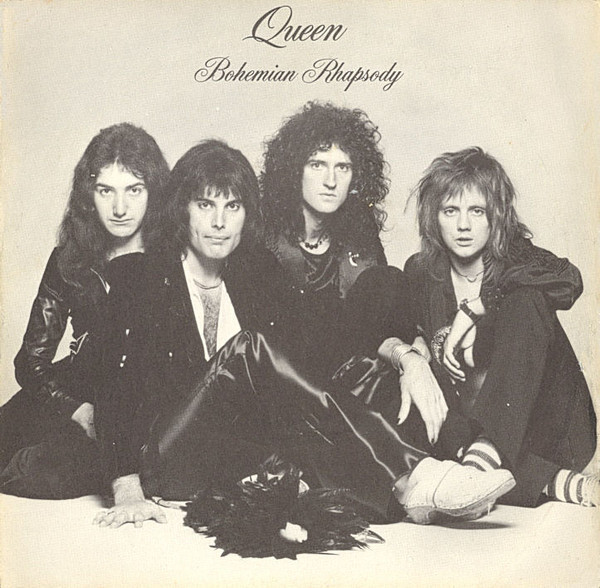
“Bohemian Rhapsody” – Queen
Pop
#2 peak (May 9, 1992)
#39 year-end, 20 weeks on chart
Mainstream Rock
#16 peak (May 2, 1992), 10 weeks on chart
UK
#1 peak (December 21, 1991 – January 18, 1992)
#2 year-end (#15 overall), 14 weeks on chart
Ineligible, #18 on Billboard Year-End list for 1976 (all stats shown are from re-release)
I’ll get to this when I do 1976.

“Smells Like Teen Spirit” – Nirvana
Pop
#6 peak (January 11, 1992, February 8, 1992)
#32 year-end, 20 weeks on chart
Modern Rock
#1 peak (November 23, 1991)
#26 year-end, 20 weeks on chart (10 in 1992)
Mainstream Rock
#7 peak (February 1, 1992)
#31 year-end, 24 weeks on chart (20 in 1992)
UK
#7 peak (December 7, 1991)
#32 year-end, 6 weeks on chart
Ineligible, #26 on Modern Rock Year-End list for 1991
I’ll get to this when I do 1991.
UP NEXT: The best song 1992 had to offer. For new songs that were successful on the charts, at least.
SOURCES
Chords for “Midlife Crisis” taken from Ultimate Guitar:
https://tabs.ultimate-guitar.com/tab/faith-no-more/midlife-crisis-chords-1831954
Coplan, Chris. “Turns Out Mike Patton, And Not Axl Rose, Is The Greatest Singer Of All Time.” Consequence 25 May 2014. Web. 4 September 2022 https://consequence.net/2014/05/turns-out-mike-patton-and-not-axl-rose-is-the-greatest-singer-of-all-time/.
Key for “November Rain” from HookTheory:
https://www.hooktheory.com/theorytab/view/guns-n-roses/november-rain
Yarm, Mark. ” An Oral History Of Screaming Trees’ “Nearly Lost You.” Spin 10 August 2012. Web. 5 September 2022 https://www.spin.com/2012/08/screaming-trees-look-back-20-years-nearly-lost-you/.
Simpson, Dave. “How We Made… Ebeneezer Goode by The Shamen.” The Guardian 5 March 2012. Web. 5 September 2022 https://www.theguardian.com/culture/2012/mar/05/ebeneezer-goode-shamen.
Uitti, Jacob. “Behind The Song: ‘Little Miss Can’t Be Wrong,’ by The Spin Doctors.” American Songwriter 25 November 2020. Web. 5 September 2022 https://americansongwriter.com/little-miss-cant-be-wrong-spin-doctors-behind-the-song/.
“Hunger Strike by Temple Of The Dog.” Songfacts 2022. Web. 5 September 2022 https://www.songfacts.com/facts/temple-of-the-dog/hunger-strike.
“Song And Emotion by Tesla.” Songfacts 2022. Web. 5 September 2022 https://www.songfacts.com/facts/tesla/song-emotion.
IMAGE SOURCES
“Midlife Crisis” single cover from Austrian Charts
“November Rain” single cover from Medium
“For Love” and “Movin’ On Up” single covers from Spotify
“Nearly Lost You” single cover from SoundCloud
“Ebeneezer Goode,” “Song And Emotion,” and “Bohemian Rhapsody” single covers from Discogs
“Bad Luck” single cover from Rate Your Music
“Little Miss Can’t Be Wrong” single cover from Song Meanings And Facts
“Hunger Strike” single cover from daMusic
“Smells Like Teen Spirit” cover from NME


Leave a comment