RECAP
Before I reveal the best song of the turbulent year music had in 1977, here’s a recap of what we’ve gone through so far:
#10: The Climax Blues Band “Couldn’t Get It Right,” but that just made it all the better.
#9: The Electric Light Orchestra’s tragic love song is a “Livin’ Thing.”
#8. Brick’s “Dazz” is Disco Jazz at its finest.
#7. Heatwave’s “Boogie Nights” are always the best in town.
#6. May the force be with John Williams and “Main Title (Star Wars).”
#5. The Commodores’ best song is “Easy” like Sunday morning.
#4. The Emotions got the “Best Of My Love.”
#3. Eagles’ “Hotel California” is such a lovely place.
#2. It’s been such a “Long Time” since I’ve heard a classic rock song as good as Boston’s.
#1
For how much it defined the decade… I haven’t had much time to discuss disco on this list.
I do maintain my belief that disco was caught in an awkward middle age in 1977. It was a bit down from the previous year, with (by my count) two disco songs in the top ten of the year-end chart (“Best Of My Love” and Thelma Houston’s “Don’t Leave Me This Way”), and six disco songs in the Top 30, compared to nine the previous year. It was also the last year disco was almost solely influenced by R&B and funk, before pop and rock music artists got their hands on it with… not great results. That is a story for another day, but now I know what Bill Oakes, the supervisor to the massive and all-world-conquering Saturday Night Fever soundtrack, meant when he said, “…it breathed new life into a genre that was actually dying.”
But with all the criticisms I hammered into disco on my worst list, I promised to discuss why I like disco on this list. It’s exciting. It’s dramatic and prevents you from falling asleep. I have an ironic respect for disco simply because it’s the most over-the-top genre to ever receive mainstream recognition in the history of popular music. In what other genre could you get away with massive four-on-the-floor beats, a gigantic orchestra, and huge forces of personality as vocalists, all in the same song? I know I didn’t list it as the genre of the seventies, but disco played such a big role in the seventies, particularly its latter half, being among the wildest and craziest eras in pop music history. But aside from the main issue I have with disco, in that it was so overexposed so quickly that there was valid reason to wish for it to be blown up by a stupid radio promotion at a White Sox doubleheader, there was another key problem with disco. Disco is dated.
I don’t mean “dated” as in, “Oh, this song was so good when it came out, but now it sucks!” I mean it as in… it couldn’t belong to any other decade. When you listen to a disco song, as in a true disco song, you instantly know the time period it came out (1975-79). If it’s a more pop-oriented disco song from someone like The Bee Gees or it features a more synthesized backing track, odds are it’s from 1978 or 1979. If the song is heavily based on Philly Soul or features less bass than the typical disco track, it’s probably from 1975 or 1976. I can’t think of another time period where the original form of disco, the orchestral, R&B-based type, could have succeeded, especially with the growth of synthesized instruments and digital production in subsequent decades. Now, I know that artists like Dua Lipa have been releasing more disco-influenced records recently, but it still stands as a niche market in today’s society. And then there’s the problem of cost. With how many songs that are made based on pre-made sampling and trap beats these days, cost is as important today as it has ever been in the music industry. And disco was the most expensive genre to produce of the seventies, because you have to pay for the vocalists, the standard guitar-bass-drums band, the keyboard players, and that 40-piece orchestra you just forgot happens to play on the track too. With how much it costs to make the typical disco song, it’s no wonder the collapse in 1979 was so swift.

But it begs the question: What if a disco song, or a song heavily influenced by disco, could break from the chains the genre was shackled too and become a song that not only was great, but truly ageless? Well, if there was ever an example, it is my number one song of the year. While I don’t consider it a true disco song particularly due to its instrumentation, it is the song that linked disco to the next phase of dance music and beyond, into a world that no one had truly seen before.
Before I reveal my number one pick, let me bring up, for the 419th and final time, the importance of considering songs outside Billboard as hit songs. I planned on using songs outside of Billboard for my seventies year-end rankings for quite a while before I started working on this list, to demonstrate that there were plenty of recognizable songs that somehow didn’t make Billboard’s year end lists. But with this year, the secondary reasoning behind including the extra songs was simple. It wasn’t to blow up a novelty disco cover that you probably hadn’t heard before reading my worst list and probably won’t hear again. It was because… I wanted to talk about this song. I’ve intentionally been keeping quiet about this song the entire time because I wanted to just add the emphasis of how other songs from 1977 may have been great, but this song is in a league of its own.
The number one song of 1977 made the Cashbox year-end chart, as well as the American Radio Charts’s top 100 songs of the year and the year-end list for Casey Kasem’s American Top 40. And yet somehow, it didn’t make the Billboard year-end list, making it probably the biggest song of the year that got snubbed. Part of the reason may be because this song peaked around November, right around the beginning of the 1978 Billboard year, but the fact that this song didn’t qualify while countless terrible songs that failed to chart as high as this song did is a horrible travesty. No discussion of 1977 and its music is complete without it.
1977 may have had more terrible songs than most years of the seventies, but thanks in large part to the countless songs I’ve mentioned today that both made and didn’t make the list, it was still a good year for music. And this song is the coup de grace, the song that made the entire journey worth it.
All hail the queen of disco.
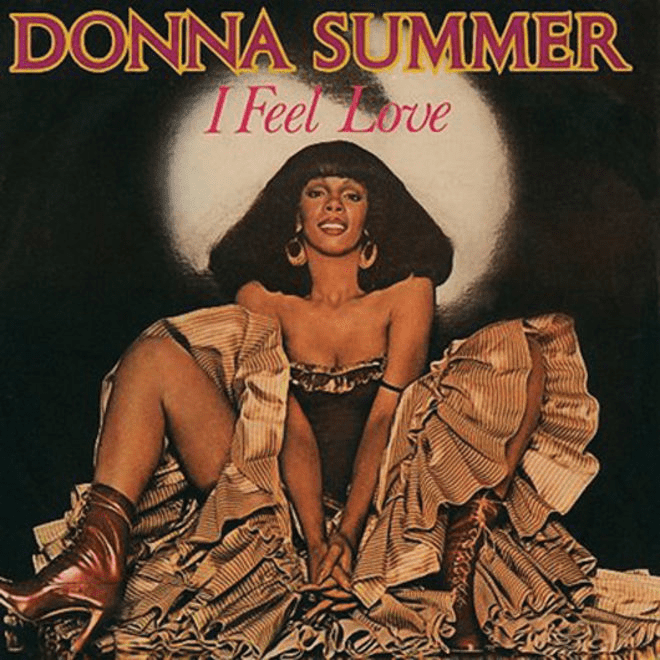
“I Feel Love” – Donna Summer
#6 peak (November 12, 1977), 23 weeks on chart (13 in 1977)
Did not qualify for Billboard year-end list
Eligible due to placement on Cashbox year-end list (#57) and American Radio Charts (#45)
Donna Summer was a legend. If you disagree with this statement, then I forbid you from reading any of my articles again. But for all the legendary tracks she recorded: the trend-setting “Love To Love You Baby,” the iconic signature song “Last Dance,” and the seminal double album Bad Girls… none of her songs touched “I Feel Love,” the 70’s disco song that stands head to toe with The Beatles’s arrival in America and “Smells Like Teen Spirit” in how it changed the world.
It’s now common knowledge that Donna Summer was one of the legendary disco performers of all time, along with The Bee Gees and maybe KC & The Sunshine Band. With that in mind, it’s difficult to remember than in 1977, when she went to the studio with her producers Giorgio Moroder and Pete Bellote to record her fifth album I Remember Yesterday, she had yet to become Donna Summer. At that point, her only real hit was “Love To Love You Baby,” along with a few minor successes, such as her disco version of Barry Manilow’s “Could It Be Magic,” and “Spring Affair” and “Winter Melody” from her previous album Four Seasons Of Love. For being one of the faces of what was considered a plastic, soulless genre, Summer clearly didn’t lack ambition, as her albums followed concepts ranging from the seasons to fairy tales. I Remember Yesterday was another concept album, where Summer and her producers conceived an album that went through pop music history, from the forties up to the present. “I Remember Yesterday” is a disco song with jazz influences, “Back In Love Again” is a throwback to the Motown sound, and “Black Lady” and “Take Me” are effective disco songs. But to conclude the album, the producers wanted to create a song that resembled the future. So many, in virtually all forms of media, fail at this by creating such exaggerated representations of the future. Summer, Moroder, and Bellotte were about to succeed with startling accuracy.
The genesis for “I Feel Love” came from an unlikely source: Star Wars. Because everything in 1977 went back to Star Wars. Anyway, Giorgio Moroder viewed the film like everyone else in 1977 and fell disappointed when he heard the aliens play their “Cantina Band” song. Finding it completely unrealistic that the futuristic aliens played an old-fashioned song with instruments, Moroder concluded, “I didn’t think it sounded like the music of the future – it looked like it, but didn’t sound like it. So I thought the only way to do it is to do it with computers – only computers.”
In order to create the music to the song, Moroder and Bellotte consulted Eberhard Schoener to borrow his Moog Modular 3P, the most modern instrument in the world at the time. Nearly all the parts of the song are played on the Moog’s sequencer, which would detune after just 20-30 seconds of recording. Schoener also lent his assistant Roddy Wedel, who introduced the producers to sequencing, which allowed them to add every track to the song automatically. Along with that, Wedel also produced the song’s bassline. In order to replicate the disco feel so it wouldn’t be completely out of place, the team spliced white noise created by the Moog to form its own hi-hat cymbal. Aside from Summer’s vocals, the entire song is synthesized outside of the bass drum. Getting back to what I think of the song, the results of all this hard and revolutionary work is amazing.
I generally don’t like synths or computerized instruments of any type. I mean, my background is in rock music. I’m not supposed to like them. For me, nine times out of ten, songs that are primarily synthesized just have this antiseptic, artificial feel to them that makes them harder for me to like. Not only that, but no matter how loud the song with synths is, it sounds way less powerful than it thinks it is, because there is no human emotion from many synthesized productions. But “I Feel Love” is not that. At all.
The entire experience of “I Feel Love” is incredible. Even though I’ve known the song since I was a teenager, about a month before I left for college, and probably heard it several times in passing beforehand, I still can’t believe this song is over 40 years old. I always love to imagine some family in 1977, driving around in their beat-up station wagon waiting in line for gas listening to sets of Jennifer Warnes and Stephen Bishop, and just imagining the look on their faces when this thing comes on. There’s no way anyone, even the edgy non-mainstream music fans listening to Kraftwerk, could have been ready for this: an almost entirely synthesized track that nothing had truly sounded like before that sounds like the most ethereal, cathartic thing. And the best thing about the music with the song is, unlike so many songs from 1977, even the classics like “Foreplay/Long Time” and “Best Of My Love,” “I Feel Love” hasn’t aged a day. It still sounds like a current pop song after all these years. I don’t make bets with people, but I will say this: If I could bet on one song from 1977 that would be a mainstream hit today, it would be “I Feel Love.” As great as they are, the Star Wars theme wouldn’t get played on radio, and all the AM pop songs sure wouldn’t. Even “Hotel California” and “Somebody To Love” would be questionable as potential hits, due to their long running times and lengthy outros. There is no such way you could knock down “I Feel Love.”
And not only does “I Feel Love” still sound like a current song despite being made in the seventies, it sounds amazing. The entire sound is huge and dominating in a way so many songs attempting to replicate it have failed since. It’s all set up by that ethereal opening chord, which sounds like being transported into a new world, before you are hit with the massive wall of synths with that pulsing bassline and the heroic ascending pattern. Combined with Summer’s vocals, “I Feel Love” sounds like a futuristic ascent into heaven – a song that hurls you closer and closer to the great beyond. As this is the first electronica hit song, Moroder and Bellotte really needed to deliver with the music in order to bring this style to the masses. “I Feel Love” more than qualifies. And none of it sounds synthetic at all: it sounds like a natural progression in the development of music. The seventies started with the continuing embers of psychedelic and acid rock as well as Motown soul and evolved into progressive rock and hard rock as well as Philly soul and disco, this is the next step: a step that evolved from just going to the next step to going into the great beyond.

Then there are the lyrics. On paper, Summer’s lyrics are really, really sparse. It’s just several repeated phrases for each verse, and the chorus only consists of three words: the song’s title. But “I Feel Love” describes its basic concept of love in the most profound, cathartic way. Few songs have ever been able to project so much with so little.
Pete Bellotte wrote most of the lyrics, but Summer delivered the meaning. During the making of the song, Summer had just fallen in love with Bruce Sudano, from the R&B/Disco group Brooklyn Dreams. Late in 1978, Summer and Brooklyn Dreams lead singer Joe Esposito would team up for one of Summer’s best hits, “Heaven Knows.” Unable to sort out her situation with Esposito and her then-current relationship with Peter Muhldorfer, whom “Love To Love You Baby” is about, Summer visited her palm reader for a recommendation. Apparently, the future beat orgasms. The palm reader suggested Summer go with Sudano, and the two eventually married and stayed together until Summer’s death in 2012. Summer’s vocal was delivered almost immediately after realizing Sudano was the one, and on “I Feel Love” it truly sounds like it.
Donna Summer delivered her vocal in one take. How her vocal, which spends almost the entire song in heavenly heights, took just one take is incredible. But even more incredible is the feeling and conviction in her voice. With her vocals, “I Feel Love” turns from a potential throwaway lyric to a final conclusion on the meaning of life: she truly does feel love. “Heaven knows” refers to how Donna hasn’t just found love, she’s found true love, the love that will last a lifetime. “Fallin’ free” is about how there’s no way to stop it, she just has to let true love happen. The entire thing is about that feeling you get when you meet that someone who means so much to you, you won’t ever be able to replicate that experience. Love as described in “I Feel Love” is a one-time event.
In both music and vocals, “I Feel Love” is a marvel. Disco as a genre never quite topped the futuristic sound of the Moog Modular on this song, and try as she might, from her powerful chest voice in “Last Dance” and her unbelievably long high note in “Dim All The Lights,” Summer never topped her head voice on “I Feel Love,” which was just otherworldly. These two factors assured that “I Feel Love” would be a song unmatched, by any song from any genre, in 1977. From the start of this project, I knew this was going to be my number one. The real test of this project wasn’t finding the number one song, but in filling out the other nine slots in order and deciding on ten other songs to make the Honorable Mentions. Even if I included all songs from this year and made “”Heroes”” or The Sex Pistols eligible, I doubt they’d knock off “I Feel Love.” When this song comes on the radio, God help that poor soul who changes the station.
1977 may have not been the best music year of the seventies, but it was a good year for music overall. And while it may not be as talked-about as 1975, 1976, or 1978, I’m glad I chose it for my first seventies countdown because it captured the seventies in every shade. It was fun, it was agony. It was intimate, and it was also extremely melodramatic. It was both unusually intelligent and incredibly stupid. And as a year where the pop music world was in transition, pop, R&B, disco, rock, and funk all crashed the party in an attempt to steer the direction of the year. While the battle would become one-sided in favor of disco for the next one and a half years, 1977 was a last reminder of the great free-for-all that existed beforehand. While this project took way longer than my previous projects just to write and release, and I had tons of rotten sewage to wade through from soft rock to disco in order to make it out alive, I’m so happy that I got to end the project on this song.
In the midst of one of the craziest pop music years we’ve had to date, one song came along that set the course of an entirely new genre, and became the starting point that would eventually lead to Hi-NRG, techno, and so much more. It stands as a monolith today, as the greatest song Donna Summer ever made, the greatest dance song of the disco era, and one of the greatest songs of all time. “I Feel Love” is the best song of 1977.
BEST LIST NOMINEES
The nominees for the best song of the year were…
“Dancing Queen” – ABBA
“Walk This Way” – Aerosmith
“I Just Want To Be Your Everything” – Andy Gibb
“So Into You” – Atlanta Rhythm Section
“Isn’t It Time” – The Baby’s
“Love So Right” – Bee Gees
“Foreplay / Long Time” – Boston
“Lido Shuffle” – Boz Scaggs
“Dazz” – Brick
“Couldn’t Get It Right” – Climax Blues Band
“Devil’s Gun” – CJ & Co.
“Easy” – Commodores
“Free” – Deniece Williams feat. Jerry Peters
“I Feel Love” – Donna Summer
“Hotel California” – Eagles
“Livin’ Thing” – Electric Light Orchestra
“Telephone Line” – Electric Light Orchestra
“Best Of My Love” – The Emotions
“Go Your Own Way” – Fleetwood Mac
“Dreams” – Fleetwood Mac
“Cold As Ice” – Foreigner
“Southern Nights” – Glen Campbell
“Rich Girl” – Hall & Oates
“Barracuda” – Heart
“Boogie Nights” – Heatwave
“Main Title (Star Wars)” – John Williams & The London Symphony Orchestra
“Swayin’ To The Music (Slow Dancin’)” – Johnny Rivers
“Keep It Comin’ Love” – KC & The Sunshine Band
“Calling Dr. Love” – KISS
“You Make Me Feel Like Dancing” – Leo Sayer
“How Much Love” – Leo Sayer
“Blinded By The Light” – Manfred Mann’s Earth Band
“You Don’t Have To Be A Star (To Be In My Show)” – Marilyn McCoo & Billy Davis, Jr.
“Got To Give It Up” – Marvin Gaye
“Somebody To Love” – Queen
“Car Wash” – Rose Royce
“Black Betty” – Starstruck (as Ram Jam)
“Fly Like An Eagle” – Steve Miller Band
“I Wish” – Stevie Wonder
“Give A Little Bit” – Supertramp
“Don’t Leave Me This Way” – Thelma Houston
“Maybe I’m Amazed (live)” – Wings
SOURCES
Kashner, Sam. “Fever Pitch.” Movies Rock. The New Yorker Fall 2007. Print. 9 August 2022. Information gathered from Wikipedia: https://en.wikipedia.org/wiki/Bee_Gees
“I Feel Love by Donna Summer.” Songfacts 2022. Web. 9 August 2022 https://www.songfacts.com/facts/donna-summer/i-feel-love.
Brewster, Bill. “I Feel Love: Donna Summer and Giorgio Moroder Created The Template For Dance Music As We Know It.” Mixmag 22 June 2017. Web. 9 August 2022 https://mixmag.net/feature/i-feel-love-donna-summer-and-giorgio-moroder-created-the-template-for-dance-music-as-we-know-it.
Reynolds, Simon. “Song From The Future: The Story Of Donna Summer and Giorgio Moroder’s ‘I Feel Love.’” Pitchfork 29 June 2017. Web. 9 August 2022 https://pitchfork.com/features/article/song-from-the-future-the-story-of-donna-summer-and-giorgio-moroders-i-feel-love/.
IMAGE SOURCES
Single cover from WNYC
Photo of a disco ball from NPR
Photo of Donna Summer and Giorgio Moroder from Auralcrave
Photo of Donna Summer from The Guardian
 Dr. Nelson Winston
Leave a comment