And now, a reflection of the biggest musical tragedy of the year.
On October 20, 1977, just two weeks before the end of the Billboard year, and 15 years and a day before I was born, Lynyrd Skynyrd boarded a Convair CV-240 in Greenville, South Carolina after a concert. Just three days earlier, the band had released their fifth album Street Survivors, which marked a return to form for the band with “What’s Your Name” (eligible for 1978) and the insane guitar work of “I Know A Little,” a near miss for my Sins of Omission. Lynyrd Skynyrd was flying to Baton Rouge to perform at LSU, and was three weeks away from their first show at Madison Square Garden, an event that would mark a landmark for the group. Simply put, the band never made it to MSG, and didn’t even make it to Baton Rouge that night. The plane they boarded crashed in Mississippi, killing 6, including lead singer Ronnie Van Zant, new guitarist Steve Gaines, and his sister Cassie among them. The band promptly went on a ten year hiatus, and although they have since reunited with mostly new members, they have never been the same band. The Lynyrd Skynyrd plane crash was unmistakably a tragedy, stripping us of the greatest Southern rock act of the time and cementing their status as arguably the most snakebit band in the history of popular music.
While Lynyrd Skynyrd may have been the unluckiest band ever, another band, from the complete opposite side of the musical spectrum in the worlds of disco and funk, had their breakthrough around the same time, in late 1977. And they would prove to be nearly as snakebit as the former band, for several more stunning tragedies as well as departures that would occur at the turn of the decade.
And not only was the demise of this band tragic also, it was a massive loss of potential. Because when this band was at their best, they were really, really good.
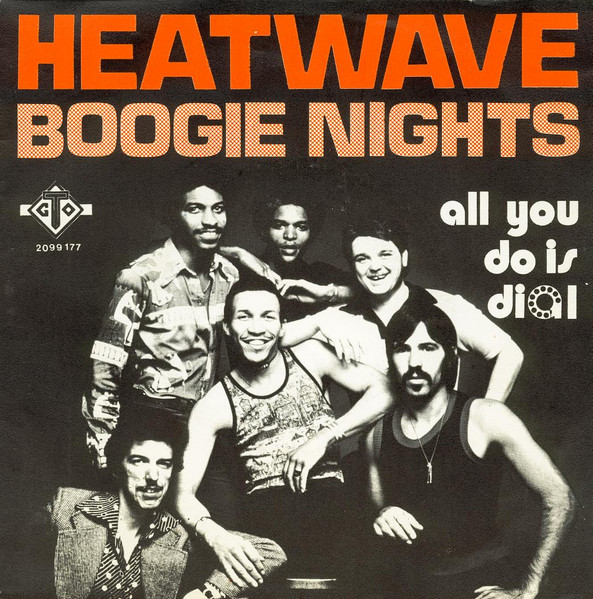
“Boogie Nights” – Heatwave
#2 peak (November 12-19, 1977)
#93 year-end, 27 weeks on chart (15 in 1977)
A common uniting factor for disco’s revival is the fact that unlike Rock and R&B, it was the first genre outside of straight pop music where it didn’t matter whether you were white, black, purple, teal, or whatever: all that mattered is whether or not you could own the groove. But even with its more diverse cast of characters, I can’t think of many disco groups with a more spread-out background than Heatwave: its band included lead vocalist Johnnie Wilder Jr., a singer from Dayton, Ohio previously stationed in Germany, British keyboardist and songwriter Rod Temperton, and Swiss bassist Mario Mantese among other members. And yet Heatwave brought out among the tightest rhythm sections and incisive songwriting in the late seventies.
Heatwave have three hit songs, all of which came out within a year of each other. They are in order this song, “Always And Forever,” and “The Groove Line.” “Always And Forever,” the R&B ballad that set the stage for many inner-city proms the world over, has become their signature song – and probably the “worst” hit they released. I say “worst” sarcastically because as a slow song, “Always And Forever” is perfectly fine and effective as a romantic ballad. It’s just… their disco jams were incredible. “The Groove Line” is yet another of the most electrifying disco songs of the decade, and already a prime contender to make my best list when I do 1978. The real question is what was better, “The Groove Line” or “Boogie Nights?” I mean, at their core they’re practically the same song. Both are songs commanding you to dance. Both songs have steady guitar rhythms and watery keyboard basslines. And lastly, both are impossible to prevent yourself from dancing to. I always say KC & The Sunshine Band, one of the biggest disco acts of the age, were the ultimate example of a band that just played the same song over and over again (specifically, “Get Down Tonight,” “That’s The Way (I Like It),” and “(Shake, Shake, Shake) Shake Your Booty”), with each same song being good. Well move over Harry Wayne, because Heatwave’s songs are arguably better.
Let’s start off with the opening. Most people probably know “Boogie Nights” largely for its main disco segment, which lasts for 3 ½ minutes of its 5 minute run time, with most radio edits fading out during the “Boogie, Boogie nights” outro. They may not be familiar with how the song starts and ends, with a mystical harp, string section, and drum pattern introducing the song while the band sings “Boogie nights, oh-oh-oh” in the background. I’ve grown to absolutely love these segments. The harp is usually one of the worst instruments you can use in a song, as all it does is add unnecessary melodrama to the ending of a song. But on “Boogie Nights,” it’s creating that mystical feeling that proves the song as a fantasy, in the best way possible. With the way it starts and ends, “Boogie Nights” resembles stumbling across a disco oasis in the middle of a desert. If disco songs resembled musicals, this is disco’s Brigadoon: A disco song and club that appears out in the mist of the Scottish highlands, for only one day per century. Just change the setting to the aforementioned Arabian desert. It just works better for the song. Trust me.

Then when the song gets going, one thing is certain. This groove is just so tight. Listen to that rhythm guitar part by Eric Johns, where he plays that E7#9 chord over and over. If there was ever such a controlled groove that still sounds natural and not stiff and programmed, this is it. Johns’ guitar part could just keep the groove going all night long. Adding to it is Rod Temperton’s versatile keyboard playing. Temperton starts with his watery keyboard bass part, followed by his synth solo in the bridge. So many synth solos like this fair since they sound so artificial, but Temperton’s solo is fun and just so happy, that it just continues the call to go to the dancefloor. Interestingly, Johnnie Wilder Jr. does not sing lead vocals on this song, with his brother Keith singing lead with his tenor vocals instead. Consequently his vocals aren’t quite as impressive as Heatwave’s subsequent singles, but he does have some cool moments, particularly his falsetto at the “Can you show that you know how to do it” bridge.
Finally at the end, we get the extended conversation between two band members regarding the song, behind the seemingly robotic “Boogie, boogie nights” passage. After listening to it several times, I don’t quite have an idea what they’re saying but it sounds like they’re in wonder at the fact that people are still “boogieing” at the disco. But do you have to be so shocked? “Boogie Nights” is without a doubt one of the best disco songs and best dance songs of the year, with how it so effortlessly merges the rising genres of disco and funk. And given that this was their first hit song, it just demonstrates how huge Heatwave could have become had it not been for their tragedies. I advise you to turn off the boogie for this next paragraph, because Heatwave have one of the most gut-wrenching endings to their mainstream period.
In 1978, Heatwave followed up the success of “Boogie Nights” and “Always And Forever” with their second album Central Heating, which includes “The Groove Line.” Later that year, Rod Temperton left the band to become a full-time songwriter. Heatwave never had another hit song after he left. Temperton’s resume as a songwriter includes “Give Me The Night” by George Benson, “Baby Come To Me” by Patti Austin and James Ingram, and several of Michael Jackson’s greatest songs, including – no joke – “Rock With You” (my favorite MJ song), “Burn This Disco Out,” and “Thriller.” Jesus. Just imagine the alternate universe where Heatwave do the zombie dance. But then it got worse. Later in 1978, bassist Mario Mantese attended a party in London with his then-girlfriend, who went home early. When Mantese arrived home that night, his girlfriend stabbed him in the heart, paralyzing him, leaving him in a five-week coma, and nearly killing him. Somehow, Mantese survived and regained his ability to walk and speak, but his music career was over. Finally, in February 1979, frontman Johnnie Wilder Jr. was driving near his home in Dayton when his car crashed into a dump truck, leaving him paralyzed from the neck down. In less than a year, two of Heatwave’s six members were paralyzed, and two others quit, with one of them off to bigger and better things. That is absolutely horrible.
But for how terrible the ending was, nothing can take away the good that Heatwave brought us when they were in their prime. And “Boogie Nights” may be the prime example. With its impossibly tight construction and its positive vibes, maybe it showed us that their explosive combination of disco and funk was just too amazing to last for more than a short time.
UP NEXT: With the dance floor closing for now, we’re heading to the movies at #6. Can’t think of what film we’re seeing? Well, what else could it be?
SOURCES
“Gillsburg Plane Crash Kills Six, Hurts 20 Including Rock Singers.” Enterprise-Journal [McComb, MS] 21 October 1977. Print. Pg. 1. Southern Tribute To Lynyrd Skynyrd 2014. Web. 5 August 2022 https://web.archive.org/web/20141225015928/http://tennesseeconcerts.com/planecrash.
Chords taken from Jason Read – Guitar Lessons: https://www.youtube.com/watch?v=dl7A49lGaoE.
“The Story Of Heatwave.” Unsung 27 September 2010. TV One Network. TV Show. 5 August 2022. Information gathered from Wikipedia: https://en.wikipedia.org/wiki/Heatwave_(band)#cite_note-Unsung_2010-2.
Clayson, Alan. “Johnnie Wilder [sic] Jnr.” The Guardian 19 May 2006. Web. 5 August 2022 https://www.theguardian.com/news/2006/may/20/guardianobituaries.usa.
IMAGE SOURCES
Single cover from Discogs
Photo of Heatwave from Soulwalking
 Dr. Nelson Winston
Leave a comment