Before we reveal the best song of the year, here’s a list of some well-deserved honorable mentions.

“Dancing Queen” – ABBA
#1 peak (April 9, 1977)
#12 year-end, 22 weeks on chart
While my foray into music criticism has provided me with numerous frustrations, one of the good things about this new venture I’m going on is I get to rediscover old songs and find out that I like them more than I used to. And probably the biggest example I can think of regarding this phenomena is this song. When I came into this project, I just thought it was decent – a good song, but in no way deserving to make the best list considering all the great music that was released in 1977. By the end, “Dancing Queen” turned into one of the most painful cuts I had to make from the best list.
When I relistened to the song, not much really changed about it in terms of its sound or composition. The song, at its core is yet another song encouraging someone to dance because they are the best dancer ever. Positive, yes, but not entirely unique subject matter in disco, as songs like “He’s The Greatest Dancer” would prove. And it’s obviously the most played ABBA song out there, which usually doesn’t increase my excitement when it comes to hearing a song again. So what changed my opinion about “Dancing Queen”? Well, it’s pretty simple. “Dancing Queen” is just so happy.
Few songs in pop music history sound as glorious as “Dancing Queen.” Just listen to how it starts with those alternating A and D chords. This song truly is the embodiment of something amazing happening, with its angelic choir and its fittingly wintry piano. And there were no better voices on Earth to sing this song other than Agnetha Faltskog and Anni-Frid Lyngstad. Their vocal performance is the musical equivalent of two people jumping up and down in ecstasy after seeing their idol for the first time. And it’s truly fitting, because that’s what this song is about: being in awe at the skills of the titular “Dancing Queen.” The contagious happiness and positive vibes this song generates finally won me over.

“So Into You” – Atlanta Rhythm Section
#7 peak (April 30-May 14, 1977)
#38 year-end, 19 weeks on chart
Guys… I’m sorry. Yes, Atlanta Rhythm Section is in my Top 20 for the year-end list, and not Queen. The only way I can explain it is, I love this song. “So Into You” became a big song of mine during quarantine, and listening to it several tens of more during this project did little to dampen my spirits regarding this song.
So what’s so great about “So Into You?” It’s not very complex in its minor key composition, and while it’s a Southern Rock song, it was clearly toned down to appeal to a wider audience. And it’s yet another silly love song about falling desperately in love with a stranger, which the protagonist hopes will lead to sex because, you know, pop music. “So Into You” is a great song because it’s so entrancing, just like the subject matter of the song, and that mellow groove could go on forever.
I mean, just listen to that hypnotic F minor chord that dominates the verses and choruses of the song. And especially listen to Dean Daughtry’s keyboard in the intro as well as the verses and choruses. While the instrumentation on this song is great all around, Daughtry’s keyboard is the gateway drug to getting hooked on this song, with how heavy it weighs on the listener. And Ronnie Hammond may not be the greatest singer, but his vocals are perfect for this song, with how mellow and soothing they are. He truly sounds like he just got hypnotized by the “voodoo in [her] eyes.” And Barry Bailey’s guitar playing ranges from the melodic riff at the end of each chorus that is really, really hard not to hum along to, to just flat-out shredding on the outro solo. All of these parts add up to a simple truth: I am so into this song.

“Devil’s Gun” – CJ & Co.
#36 peak (July 16, 1977)
#100 year-end, 29 weeks on chart (24 in 1977)
Few may remember this jam from 1977, but all I can say after hearing this song at the very edge of the year-end list: Dang. I don’t know what it is about disco, but when artists ventured outside the typical songs about love and sex and went for danger and excitement, the results were often amazing. And “Devil’s Gun” is a seven-minute assault of breathtaking, powerful disco music against a message calling for prompt action against a fearful nemesis.
C.J. and Company are so obscure these days, that I did my homework on the group in preparation for this entry and I don’t even know who their frontman was. The most I can tell you is they were a five-piece vocal group from Detroit put together by Mike Theodore and Dennis Coffey, the latter of whom is best known for his 1971 hit “Scorpio.” They do put together a fine vocal performance that appropriately emphasizes the danger of standing in front of the devil, but what really stands out about this song is the production. Greg Coles and Roderick Chandler’s bass patterns are steady as a drum, rolling out its repetitive D note. Coffey’s guitar solo in the interlude is slashing and fierce as the song builds tension. But the true star of the show is not the group or the standard instruments, but that incredible orchestra. Orchestras could often be a big hit or a huge miss when it came to 70’s R&B and disco, but man was adding an orchestra the right decision for “Devil’s Gun,” since it elevates the conflict and drama of the song in a way the lyrics can’t. The descending string flourishes at the end of each main riff sound like they were supposed to be in the greatest superhero or science fiction movie you never saw, and that epic ascending sequence from F to C in the chorus is heart-stopping; the moment in the song where the subject realizes he’s got only a few seconds left before succumbing to the titular devil’s gun.
He’s watching us burn, he’s watching us burn
One day we’ll learn, one day we’ll learn
This song was the first song ever played at the legendary Studio 54 for a very good reason. “Devil’s Gun” is, without a doubt, one of the most exciting disco songs that saw the light of day during the second half of the seventies, and the amount of tension that builds during the sign is unbelievable. I take it that when patrons at Studio 54 dropped Quaaludes and overdosed on heroin, they were in fact looking down the barrel of the devil’s gun.
Author’s Note: Since I initially wrote this entry, I’ve learned that not only is Charles Clark (Libra from The Floaters) one of the members of C.J. & Co., but “Float On” keyboardist Gary Schunk also performs on this song. Talk about redeeming yourself.
“Dreams” – Fleetwood Mac
#1 peak (June 18, 1977)
#39 year-end, 19 weeks on chart
This was the song from Rumours I tried to get on the list, and initially while planning the best list, I planned on having this at #10. But when I decided to focus on the songs I truly loved and vote my heart, “Dreams” was a casualty, as its placement was primarily based on its importance as a standard rather than my personal tastes. That being said, that doesn’t mean I don’t think “Dreams” is a great song.
“Dreams” is one of the best songs from Rumours, and no, it’s not because some guy was skateboarding to the song on TikTok in 2020. It’s because of the singles from Rumours, this song has the best sense of melody. Instead of sounding like just another soft rock song, “Dreams” really adds another dimension by adding that dance drum beat from Mick Fleetwood. With those drums, Fleetwood prevents this song from being a slog like so many other in its genre, and moves the song along at a brisk pace. And Christine McVie’s Fender Rhodes piano and Lindsey Buckingham’s lead guitar are solemn and mournful, the perfect atmosphere Nicks’s breakup song needed.
I don’t think I need to explain more about this song, as this is one of the 1977 songs that everyone knows. “Dreams” pretty much speaks for itself. On the other hand, some songs regardless of their popularity require more analysis, such as…
“Go Your Own Way” – Fleetwood Mac
#10 peak (March 12-19, 1977)
#94 year-end, 15 weeks on chart
So, to make up for having no Rumours on my best list, I’ll be listing two songs from the album on my list from honorable mentions, plus the aforementioned “The Chain” on the list of songs that should have been successful in 1977. While Stevie Nicks’s “Dreams” is catchier and easier to connect with on a musical level, it is Lindsey Buckingham’s answer song, “Go Your Own Way,” that is the more powerful song lyrically.
“Dreams” is not a bad song lyrically. The song doesn’t fall into the breakup song lyrical traps of sounding whiny or immature, it just sounds like a woman coming to grips with the new reality. But “Go Your Own Way” pulls no punches. With Nicks making the decision to end the relationship, Buckingham finally let his frustrations out on this song.
If I could
Maybe I’d give you my world
How can I
When you won’t take it from me
“Go Your Own Way” is all about the bafflement, the shock, when someone who was your main ally for six years is gone. Probably more than any other song on the album, far more than “Second Hand News” (the other Lindsey Buckingham breakup song on the album), it examines the pain of a breakup. It probably isn’t surprising, in that regard, that Stevie Nicks was not a fan of this song and found it mean-spirited, particularly the line that accused her of “shacking up.” Whether the criticism or not is fair, it is the brutal honesty that makes “Go Your Own Way” one of the best songs on Rumours. While you can simply gloss over the conflict on “Second Hand News” or “Dreams,” you can’t do that with “Go Your Own Way.” It’s a song that makes you think about the heartbreak a breakup can cause you, and how difficult the conflict must have been for Fleetwood Mac when they entered the studio to record their masterpiece.
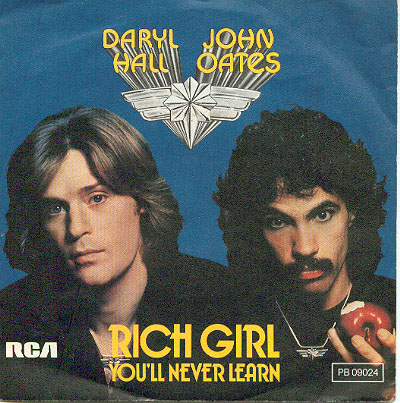
“Rich Girl” – Hall & Oates
#1 peak (March 26 – April 2, 1977)
#23 year-end, 20 weeks on chart
Do you want to know how hard these honorable mentions were to put together? Up until the final few days I was finalizing my list, this song wasn’t even going to be here. I pulled it up at the last moment, because even though it may be another two minute song about a toxic woman, “Rich Girl” remains yet another Hall & Oates song that is true pop music bliss.
First off, for those who may think this is just two sexist guys trashing some random woman… it’s not about a woman. It’s about a man. “Rich Girl” was written about Victor Walker, the ex-boyfriend of Daryl Hall’s longtime girlfriend Sara Allen, who was the heir to a fast food franchise. Hall & Oates switched the song title because they couldn’t get “Rich Guy” to sound right. Second off, when the defining characteristic about the song’s protagonist is “you can rely on your old man’s money,” don’t you think that the song’s criticism is a bit well-deserved? Seriously, why sympathize with someone who doesn’t have to take responsibility for her – I meant his actions? But the justified criticism isn’t why “Rich Girl” got nominated, it’s because this is yet another Hall & Oates song that just sounds great.
Hall & Oates were a particularly skilled singles band, two musicians who just had the ability to write the best hooks that you can’t help but lip-synch to. Sometimes, the hooks came in the points where you least expected it, which is what happens here. The hook that stays with you is not the chorus, but the three-note opening melody line with the “Don’t you KNOW!” that ascends from F to A. It’s just so cathartic, making the song’s conflict worth it. And it’s also noteworthy how the song slowly builds to its climax in the final chorus, with Hall’s vocals and the string section reaching greater elevation at the “say money but it won’t get you to far” line.
And finally…
It’s a b***h girl, but it’s gone too far
(GASP!) DARYL HALL SAID THE B WORD!
Seriously though, I’m not 12 anymore. It’s just a little shocking knowing that it’s one of the first #1 hits that drops a swear word in the chorus. What’s up next?
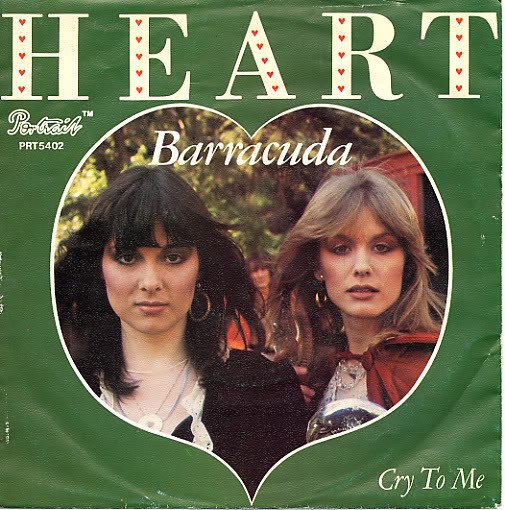
“Barracuda” – Heart
#11 peak (September 3, 1977)
#53 year-end, 20 weeks on chart
Oh, yes. Some songs are just so amazing because of that riff. And “Barracuda” more than qualifies. That epic guitar riff and Ann Wilson’s impassioned vocal performance and lyrics make this more than qualified as one of the best rock songs of the year.
First off, that main riff. It’s been impaled in my brain since I was a kid. It became permanent when I played the song endless times on Guitar Hero III as a teenager (and a gateway drug to explain Guitar Hero to my Mom, as she is a huge Heart fan). When thinking of the greatest triplet riffs, my brain goes with “Raining Blood” by Slayer and this. Never mind that it’s repetitive, the main E triplet riff on “Barracuda” sounds like a locomotive that never loses steam. The song isn’t that hard to play outside the brief tapping parts in the second verse and the end of the solo, but Roger Fisher’s lead guitar riffs from the guitar solo and outro just always seem to reach for the sky, a welcome contrast to the crushing main riff.
And then we get to the lyrics. Turns out this song is about Mushroom Records, who decided it would be a good idea… to fabricate a false story claiming that Ann and Nancy Wilson were having an incestuous relationship, resulting in Heart bolting for CBS and Portrait Records and a yearlong battle between the two labels regarding who got to release new Heart music. Go screw yourself, Mushroom Records. The result is one of the most brutal and justified condemnations in the history of rock music.
And if the real thing don’t do the trick
You better make up something quick
You gonna burn, burn, burn, burn, burn to the wick
Oooo, Barracuda
Mushroom Records sure made up something quick with their pathetic rumor, and Ann Wilson took them down with all the force of a Mack truck. Gosh, this entire song is brutal, from the opening riff to Ann Wilson’s demolition squad of a vocal performance, and especially the lyrics comparing the record label to a deadly shark. Seriously, did Mushroom Records deserve anything less?
Author’s Note: Had my best list consisted strictly of Billboard year-end songs, “Barracuda” would have been #9 on the list. Consider the song the official #11 of the countdown.
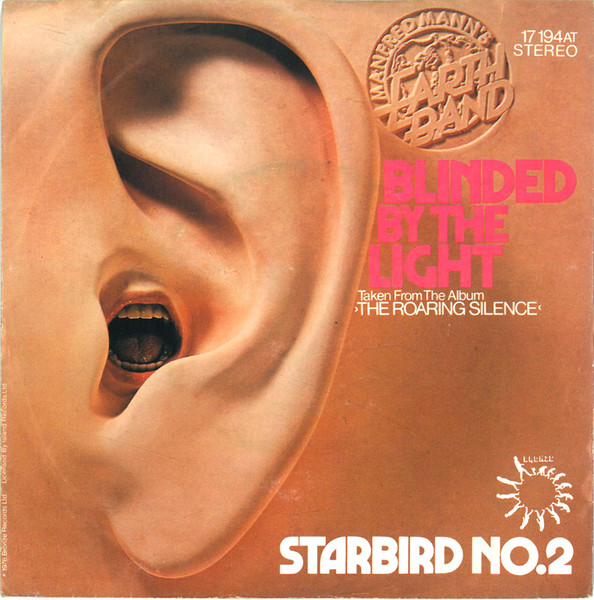
“Blinded By The Light” – Manfred Mann’s Earth Band
#1 peak (February 19, 1977)
#36 year-end, 20 weeks on chart
Let’s add to my list of controversial statements regarding 1977 as a year. “Blinded By the Light” is the first song on Bruce Springsteen and the E Street Band’s first album, Greetings From Asbury Park, NJ. Well, I’m here to say regardless of the takedown I’m at risk of getting from the boss himself, that Manfred Mann Earth Band’s version is better. The Bruce Springsteen version is good, as there was clearly a lot of effort put into the track, but begins to lose steam as Springsteen continues rambling for 5 ½ minutes. The Manfred Mann’s Earth Band version, on the other hand, is just so supersonic and huge – an encapsulation of everything that made seventies classic rock so great.
It’s kinda bizarre everything turned out in favor of Manfred Mann’s Earth Band’s version, because it’s clear that they don’t understand the lyrics as much as Springsteen did. Listening to the song makes it sound like it’s a song about a neverending, mind-bending odyssey that probably involved drugs, not the teenage fantasy of the original. But I still love this song. Part of it is where I’m from, as I’m pretty sure classic rock stations in the Finger Lakes played this song approximately 500 billion times during my upbringing. The other part is the instrumentation. Considering Manfred Mann’s Earth Band had just added a new lead singer and new lead guitarist just before this song was recorded – Chris Hamlet Thompson on the vox with Dave Flett on lead guitar – it’s amazing that it sounds as cohesive as it does. Manfred Mann’s keyboards are unstoppable and haunting as it plays that descending chord progression with devastating impact, and Flett’s wah-wah guitar solo just slowly builds in intensity before it just explodes during the bridge, leading up to the unlikeliest of climaxes in 1977 music – Manfred Mann playing “Chopsticks.” Hearing that piano play the classic tune is just haunting; it scared the heck out of me as a kid. And it somehow works because it goes from a standard to part of the song, part of the experience.
And before we move on, for the final time, it’s NOT “wrapped up like a douche.” The lyric is “revved up like a deuce,” as with the old car. Because “Blinded By The Light” is supposed to be partially about teenagers cruising Asbury Park in their car. But of course the Manfred Mann version is not about that. It’s about something bigger.
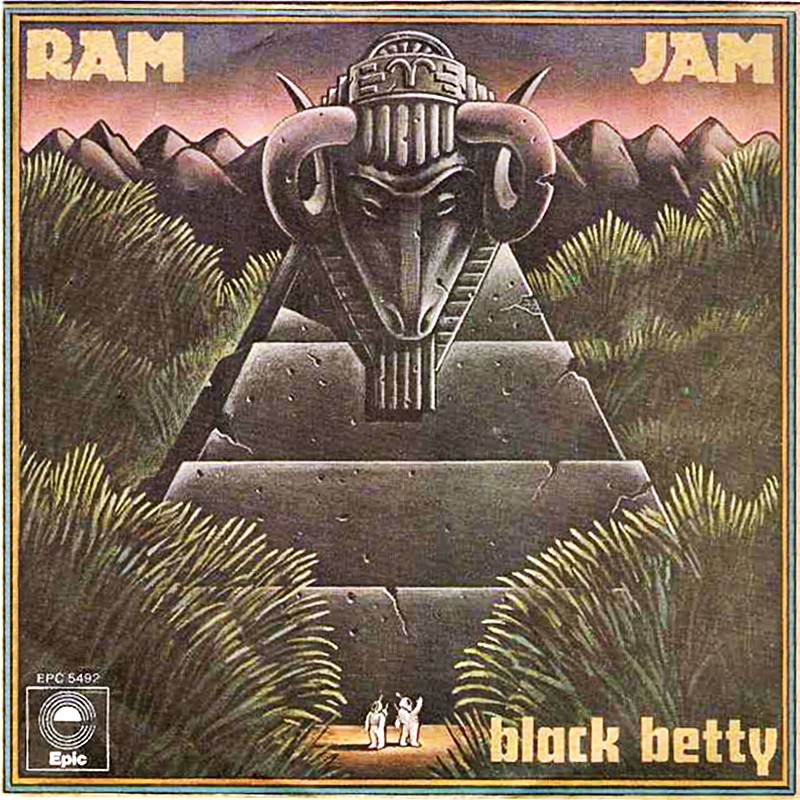
“Black Betty” – Starstruck (as Ram Jam)
#18 peak (September 3, 1977), 17 weeks on chart
Did not qualify for Billboard year-end list
Eligible due to placement on Cashbox year-end list (#63)
Oh dear God, yes. If “Barracuda” didn’t lay it out for you, I’m a wuss for almost anything with a loud, vicious guitar riff. And “Black Betty” is among the most vicious hard rock songs of the year; a song that came oh-so-close to being the third non-Billboard song to make the best list.
“Black Betty” originated as a Negro spritual song written by legendary folk artist Huddie Ledbetter in 1939. 38 years later, and 10 years removed from his previous hit song “Green Tambourine” (a number one hit for The Lemon Pipers in 1967), guitarist Bill Bartlett released a new arrangement the song, making “Black Betty” the oldest song to become a hit in 1977. And boy did it deserve it. I don’t think a single song from 1977, from a classic album or otherwise, had a better guitar tone to it than this song. Bartlett and rhythm guitarist Tom Kurtz’s guitars on the track are just thunderous and menacing, as if they’re about to take down a forest. Then when the tempo picks up for Bartlett’s woodpecker guitar solo, it just becomes the most fun romp. The song does sound a bit underproduced, but that just makes it better; it sounds like it’s being played by someone who just plugged in his new Gibson in his parents’ garage. With its subject matter and its southern fried riffs, “Black Betty” is the best Southern rock song of the year… by a band from Cincinnati. Geography and music can be a funny thing.
“Black Betty” has been accused, since its release as a rock song, of being racist and insensitive to African Americans. This is kinda ridiculous in my opinion, since it was written by a black man (Huddle Ledbetter) and championed by Alan Lomax, who made a career out of promoting and preserving classic African American songs in a segregated society. Depending on who you ask, it’s about a whip, whiskey, a car, or a gun. Or a woman, as Bartlett rewrote the lyrics and based them on a pinup from the fifties. Regardless of what meaning is correct out of these five, “Black Betty” is mostly about that riff. It’s just so massive that it can’t be stopped.
For those of you confused by my artist label this time out, Ram Jam, the artist usually credited with the song, doesn’t actually play on the track. Bill Bartlett recorded the song with his previous band Starstruck shortly before they disbanded, and by the time “Black Betty” gained traction on radio, producers in New York City formed a new band around Bartlett and credited the song to them. So it is in fact Starstruck who was the one-hit wonder, and Ram Jam is a no-hit wonder. While Bartlett is a two-hit wonder with The Lemon Pipers and Ram Jam. Hey Todd, if you’re reading this, I’ve got a One Hit Wonderland episode for you…

“Maybe I’m Amazed (live)” – Wings
#10 peak (April 2, 1977), 13 weeks on chart
Did not qualify for Billboard Year-End List
Eligible due to placement on Cashbox Year-End List (#94) and American Radio Charts (#95)
You’re probably wondering why a song from the cute one’s debut solo album is here, seven years after its initial release. Well… the best-known version of “Maybe I’m Amazed” was never released as a single. Six years later, after the smashing success of their album Wings At The Speed Of Sound and their all-world-conquering “Silly Love Songs,” Paul McCartney’s supergroup Wings embarked on a massive world tour, which begat a triple live album, Wings Over America. In February 1977, McCartney’s signature solo song finally received a single release in the live version recorded from that album, and reached the top ten.
I probably don’t need to tell you that this song is great. “Maybe I’m Amazed” remains one of the all-time great statements of true love in pop music. It’s all about how Paul McCartney’s wife and Wings bandmate, Linda McCartney, pulled him through one of the most difficult periods of his life, when The Beatles were on the verge of their inevitable breakup after the disastrous sessions surrounding Let It Be. That alone pulls this song above so many generic “I love you” statements, as it’s McCartney pulling from a difficult moment in his life to discuss how much Linda means to him.
Baby, I’m a man, maybe I’m a lonely man
Who’s in the middle of something
That he doesn’t really understand
Baby, I’m a man
And maybe you’re the only woman who could ever help me
Baby, won’t you help me to understand?
There’s no ego, there’s no angry demands, it’s just a man appreciating how important his wife is to him. And that is what makes “Maybe I’m Amazed” a great song.
The Wings live version that was eligible for this list isn’t as well known as the original, but it does feature some new tricks up its sleeve. Even though it isn’t as intimate as the studio version, the song adds an interesting hard rock feel with Jimmy McCollough’s lead guitar after the chorus, as well as multipart backing vocals on the chorus that add to the grander scope of the live version. And it works, surprisingly. It adds its new dimension and doesn’t take away from the power of the original message.
Despite how much I love this song, I can’t put “Maybe I’m Amazed” on my best list for two reasons. The first reason is obvious, as it feels unfair to put a song that was released seven years after its release on a respective year-end best list. Furthermore, while it does have its fair share of positives, the live version isn’t quite as good as the studio version: McCartney’s vocals fail to reach the heights of the original during the choruses, and the song begins to drag with its length at 5 ½ minutes, a minute and a half longer than the original. But no matter. “Maybe I’m Amazed” is a must for anyone looking to get into Paul the artist, and it’s still great to hear the song become the hit it deserved to be.
UP NEXT: The greatest and most revolutionary song of 1977 is up next!
SOURCES
Chords for “Dancing Queen” verified from Ultimate Guitar: https://tabs.ultimate-guitar.com/tab/misc-soundtrack/mamma-mia-dancing-queen-chords-3217598.
“This Is The… Studio 54.” Disco Guy 1999. Web. 3 August 2022 http://www.disco-disco.com/clubs/studio54.shtml.
Buskin, David. “Fleetwood Mac ‘Go Your Own Way.’” Sound On Sound August 2007. Web. 3 August 2022 https://www.soundonsound.com/techniques/fleetwood-mac-go-your-own-way.
Bronson, Fred. The Billboard Book Of Number 1 Hits. New York City: Billboard Books, 2003. Pg. 457. 3 August 2022.
“Original TV Shows, Reality TV Shows.” VH1 30 September 2016. Web. 3 August 2022. Information gathered from Wikipedia: https://en.wikipedia.org/wiki/Barracuda_(song).
Larkin, Colin. The Guinness Who’s Who Of Heavy Metal 2nd Edition. London: Guinness Publishing, 1995. 3 August 2022. Pg. 290. Information gathered from Wikipedia: https://en.wikipedia.org/wiki/Ram_Jam.
Reader, Adam. “The EXTENSIVE 200 Year Journey of This 1977 Rock Classic.” Professor Of Rock 12 May 2021. YouTube. Web. 3 August 2021 https://www.youtube.com/watch?v=wVk53xKieI4.
IMAGE SOURCES
“Dancing Queen” single cover from Stereogum
“So Into You,” “Devil’s Gun,” “Blinded By The Light,” and “Maybe I’m Amazed” single covers from Discogs
“Dreams” and “Go Your Own Way” single covers from Rate Your Music
“Rich Girl” and “Black Betty” single covers from Dutch Charts
“Barracuda” single cover from Medium
 Dr. Nelson Winston
Leave a comment