RECAP
#10: Johnny Cash’s “Ring Of Fire” was a blazing success.
#9: Del Shannon’s “Little Town Flirt” is so good, you could get hurt.
#8: Bill Pursell presented us with “Our Winter Love.”
#7: The Impressions’ first hit? “It’s All Right.”
#6: The answer to Peter, Paul, & Mary’s success is “Blowin’ In The Wind.”
#5: The Miracles “Really Got A Hold On Me.”
#4: “In Dreams,” Roy Orbison may be the greatest singer ever.
#3: With the best riffs of the year, The Chantays had a “Pipeline” to fame.
#2: The Tymes had us “So Much In Love.”
#1
I’ll be honest for you all before I reveal what was the greatest song of the year.
This was a hard list to put together.
In the year I’ve been doing top tens, the worst and best lists of 1963 may have been the hardest lists I’ve had to put together. I really underestimated the amount of work it takes to do these lists when I did my rock & alternative lists for 2020, and 1963 was even harder.
The first reason for this was because of the unfamiliarity of 1963 for most music fans, even me. I love music, I love oldies of the 1960’s and 1970’s. And yet, going into this list, I knew only about 23 of these 100 songs. Many of which I had only heard in passing. So I had to hear these 100 songs, over 75 of which I was hearing for the first time from start to finish, form an opinion on them, and rank them. Adding to that, a good number of the songs began to blend in with each other. As I mentioned on my worst lists, there were tons of breakup songs. As I mentioned today, there were tons of instrumentals. There were a lot of girl group songs. After a while, I had to stop rating many of these songs and just go with the ones I thought were the best or worst examples. The only real reason 1963 screamed out at me is that it was the year my parents were born, no one had gone in-depth with the year except for the bloggers who do every year, and I wanted to know what it was like.
Last year, Sean Fay-Wolfe and Lyzette G, two of the most popular YouTube channels that does these types of lists, attempted to do a similar best/worst project for 1962. After a time, they quit the project and switched to 1966, probably one of the best years in pop music history, because as Sean stated, “the songs were so samey and lame that I felt the life draining out of me with each passing song.” And while I could ask why he didn’t complete an early 60’s project when I pulled it off with considerably less music criticism experience under my belt, I don’t blame him. While the 70s and especially the 80s have numerous musical aspects present in pop songs that are still being used today in 2021, there is none of that in the early 1960’s. It represents a time where every aspect of the song – from its lyrical content to its instrumentation to especially its production – was different. And as the last year before The Beatles arrived in America, 1963 is the last frontier for the halcyon days of pop music.
The second reason this list was difficult to complete was because it was hard to determine what should constitute the best song of the year. While some focus on their personal opinions and others rate the songs objectively, I try to combine the two. And 1963 put me at a crossroads.
My number one slot came down to four songs. Of the four, one was probably the objective best song of the year – “In Dreams.” It is the most unique of the four, the most dramatic, and definitely the best singing performance of the year. But as I stated before, the song is so intense I can’t imagine putting it on every time I come back to this year. There are two songs that have become my absolute favorites of the year: “Pipeline” and “So Much In Love.” I absolutely love these songs and would run out to listen to them whenever I am given the opportunity. But all of them felt like dark horse contenders, because they all have an unusual characteristic that makes sticking up for them in the top slot difficult. “Pipeline” is an instrumental, and “So Much In Love” has hardly any instrumentation. While they worked with all these shortcomings in amazing ways, putting either of them at number one felt overly generous.
And then there was one other song I considered.
Of the 23 songs I knew heading into this countdown, this was one of them. I already liked the song heading into my music top ten list career. I got familiar with the song again when I did my list of the best dance songs of the 1960’s, and that like turned into love. And then when I considered the best songs of the year, once this one came up I knew it had to be the one.
It’s not only the best song of the year, it’s one of the greatest songs of the decade in general (even counting the massive amount of great music that came around later in the decade). Additionally, it’s the greatest song in the girl group era – the subgenre that kept the excitement of pop music alive in music’s lowest point of the decade. And considering that no one who has covered this year’s best songs has put it on a best list yet, I figured it’s time to give this song its just due.
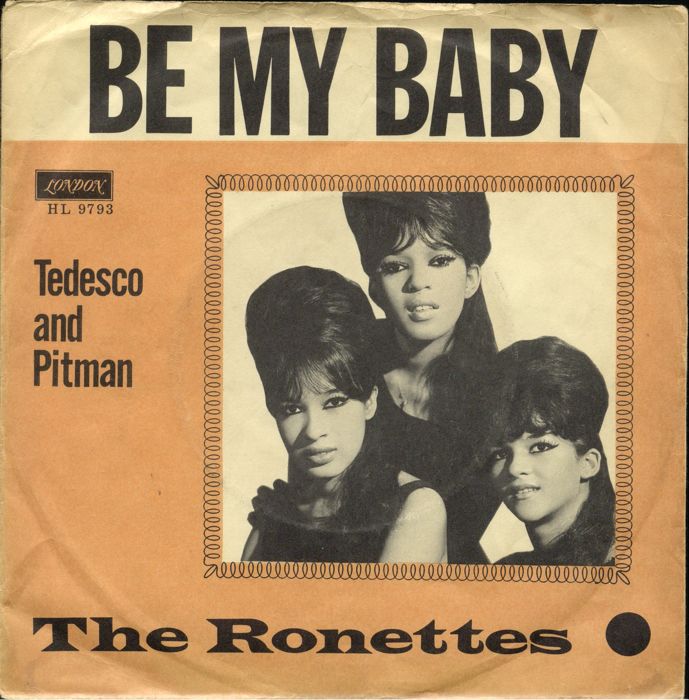
“Be My Baby” – The Ronettes
#2 peak
#45 year-end
If you were to sum up everything that was great about early sixties pop music, “Be My Baby” would be the song you would use as a guide. It is the peak of Phil Spector’s Wall Of Sound, to the point that even in spite of his list of sins which involve ruining The Beatles’ final single and actual murder, I now totally understand why he is considered one of the all-time greatest producers. “Be My Baby” is three straight minutes of complete lighthearted happiness, to the point that I can’t sufficiently describe it in words. But as the best song of the year, I’ll try.
I don’t know where to start about how great this song is, so let’s start off with the beginning. The opening of the song, to me, is so important with setting the pace of the song. This is the part where you want the song to hook you in before the vocals begin, to give you a preview of what experience you’re going to be in for. Ideally in this part, I want a riff from the instruments to provide me something to identify the song with. If it’s just a bunch of random chords or instrumental noodling, I get a bad feeling about what we’re about to endure. “Be My Baby” starts with Hal Blaine’s four-hit drum pattern, ending with that sonic boom of a snare hit. It’s deafening. It’s incredibly powerful. It’s extraordinary that Blaine was able to set the tone for the song with his simple drum pattern. The song was able to create that opening hook with the least amount of sonic effects. Then we hear the glorious opening chord as played through Spector’s “Wall Of Sound” production, complete with its piano, keyboards, orchestral instruments, and maracas. It may be ridiculously simple, but this is a song about romance, about happiness… and this opening chord drives home the point so effortlessly.

Then there are the vocals. Ronnie Bennett (“Be My Baby” is five years before her marriage to Phil Spector, which is why I’m using her maiden name) is the only Ronette to appear on “Be My Baby,” singing both lead and backing vocals. Her future husband reportedly made her go through 42 takes of her lead vocal take, and all the hard work paid off. Ronnie’s vocals are sweet when she sings about her unconditional love for her interest, and they hit hard at the “Whoa-oh-oh-ohs” at the end of each chorus. It may not be the most emphatic vocal performance of the year, but it’s definitely one of the most effective. But what helps send this song into the stratosphere are the backing vocals, delivered by a who’s who of singers from the Wall Of Sound era, including Darlene Love and Bobby Sheen of Bob-B-Soxx and the Blue Jeans, songwriter Ellie Greenwich (who co-wrote “Be My Baby”), and Nino Tempo (the co-singer of that terrible “Deep Purple” cover redeemed himself!). Their “Ahhhhh….” backing vocals build incredible tension in each pre-chorus, and the “Be my, be my baby” backing vocals of the chorus are pure pop music bliss. While Ronnie’s vocal performance is great, the backing vocals here are a big part of what makes this song’s impact seismic.
With the music and vocals taken care of, let’s take a look at the lyrics. And on the surface, it’s your average “I love you” song.
So won’t you say you love me
I’ll make you so proud of me
We’ll make ’em turn their heads every place we go
I’ll make you happy, baby, just wait and see
For every kiss you give me I’ll give you three
But let’s try to understand the feelings this song provides. First off, in a year with, for the final time, a barrage of irritating songs about breakups and relationship drama, “Be My Baby,” a song about unconditional love, is a song we desperately needed. Additionally, I don’t even see this song as a one-sided interest. I see it as a song about a woman who’s about to begin her true romance, with the two having a blissful relationship free of conflict, regardless of what anyone around them thinks. Now combine the message with the surrounding elements. The triumphant Wall of Sound, Ronnie’s sweet lead vocal, and the perfect backing vocals. This has to be about true love.
When I look at the best songs of the year, I look for not only my favorite songs that I will return to listen to without fail, but also the songs that objectively feature the fewest flaws. “Be My Baby” succeeds on both counts. Unlike “Little Town Flirt,” “Be My Baby” could not possibly be improved upon. It has achieved its final form, and no possible edits would make this song better. Additionally, unlike “In Dreams,” “Be My Baby” is a song that I’m always in the mood for. I’m always willing to listen to it in full when it comes on a sixties playlist.
1963 may be a difficult year overall to get into musically, due to it increasingly being treated as an antiquated year with few songs worth remembering. But if you’re looking to get into the year, this is without a doubt the song I’d recommend you start with. “Be My Baby” is the apogee of the Wall Of Sound, and while it tried on songs such as “Then He Kissed Me,” it never reached the level of pure, unadulterated amazement on a musical level like it did here. And even as music reached new sounds later in the sixties that it could not have possibly dreamed of at the beginning of the decade, few songs were able to match this song in terms of musical quality, vocal quality, or overall happiness. I have no problem with declaring “Be My Baby” as the best pop song of 1963.

THE 1963 BEST SONG NOMINEES
“Surfer Girl” – The Beach Boys
“Our Winter Love” – Bill Pursell
“Pipeline” – The Chantays
“Da Doo Ron Ron” – The Crystals
“Then He Kissed Me” – The Crystals
“Little Town Flirt” – Del Shannon
“Busted” – Ray Charles
“Just One Look” – Doris Troy
“Up On The Roof” – The Drifters
“(You’re The) Devil In Disguise” – Elvis Presley
“Easier Said Than Done” – The Essex
“Cry Baby” – Garnet Mimms & The Enchanters
“It’s All Right” – The Impressions
“Surf City” – Jan & Dean
“Sugar Shack” – Jimmy Gilmer & The Fireballs
“Ring Of Fire” – Johnny Cash
“Sukiyaki” – Kyu Sakamoto
“The Monkey Time” – Major Lance
“(Love Is Like A) Heat Wave” – Martha Reeves & The Vandellas
“You’ve Really Got A Hold On Me” – The Miracles
“That Sunday, That Summer” – Nat King Cole
“Blowin’ In The Wind” – Peter, Paul & Mary
“Puff, The Magic Dragon” – Peter, Paul & Mary
“Be My Baby” – The Ronettes
“Mean Woman Blues” – Roy Orbison
“In Dreams” – Roy Orbison
“Our Day Will Come” – Ruby & The Romantics
“Another Saturday Night” – Sam Cooke
“Fingertips (live)” – Stevie Wonder
“Wipe Out” – The Surfaris
“So Much In Love” – The Tymes
SOURCES
Fay-Wolfe, Sean. “Top 10 Best Hit Songs of 2020 – Part 2 by Diamond Axe Studios Music.” YouTube 20 January 2021. Web. 13 June 2022 https://www.youtube.com/watch?v=F5K9advl4Kw&t=2009s.
“Be My Baby.” Songfacts 2022. Web. 13 June 2022 https://www.songfacts.com/facts/the-ronettes/be-my-baby.
IMAGE SOURCES
Single cover from KQED
Image of Ronnie Bennett from Biography
Image of The Ronettes from Wikimedia
 Dr. Nelson Winston
Leave a comment