DISHONORABLE MENTIONS
And now for some more terrible songs that didn’t make the list…

“You And Me” – Alice Cooper
#9 peak (August 13-20, 1977)
#48 year-end, 21 weeks on chart
You know what’s sad? Alice Cooper was a shock rocker with some dang good rock songs. But other than with “School’s Out,” that is not what he had chart success with. Instead of scoring chart successes with hits like “No More Mr. Nice Guy” and “Feed My Frankenstein,” Cooper sustained success in the latter half of the decade with some lame soft rock ballads. In 1975, Cooper scored a hit with “Only Women Bleed,” an embarrassing ballad about domestic violence. And while “You And Me” isn’t as bad as that song, it’s still incredibly lame.
The song that “You And Me” reminds me the most of is “Breakfast At Tiffany’s,” the lone hit by Deep Blue Something. That’s because like the former song, it’s a song about completely mediocre romance. He may sing about passion, but Cooper comes across as someone who seems to be settling for a lack of happiness, as outlined in the chorus:
But you and me ain’t no movie stars.
What we are is what we are.
We share a bed, some lovin’,
And TV, yeah.
And that’s enough for a workin’ man.
What I am is what I am.
And I tell you, babe,
Well that’s enough for me.
One thing we’ll get to with the nineties is my love of many rock bands that are often considered taboo in today’s climate. I love Bush, I like Presidents Of The United States Of America, I like Sugar Ray. And yet my rose-tinted glasses for the nineties have no effect on “Breakfast At Tiffany’s,” because it’s so passionless, so pointless in its existence. A couple on the edge of a breakup stay together because… they have a mild interest in Breakfast At Tiffany’s. Pathetic. And that’s the vibe I get from this song. Cooper has a bed, TV, popcorn (as outlined in the second chorus)… and that’s it. And he doesn’t seem to be that interested in making his or his partner’s life better. It’s just a boring slog of a song. His other hit from 1977, “I Never Cry,” was at least passable, but “You And Me” has no reason to exist. Stick to shock rock, Alice.

“Lonely Boy” – Andrew Gold
#7 peak (June 11-25, 1977)
#50 year-end, 21 weeks on chart
My family is going to shoot me in the face for including this song, while the rest of you may be baffled that I’m including this song, because “Lonely Boy” easily has the best music and melody of any song I’m discussing today. The opening piano riff is lively and splendid, and Andrew Gold, the son of legendary film dubber Marni Nixon, has the pipes to deliver this song’s roof raising chorus. If I was rating this song on music alone, it would be pretty positive. But then we get to the story of the song.
“Lonely Boy” is about the titular young boy who is born to parents who vow to do whatever it takes to raise him properly. And then, when he is two, this happens in his life.
In the summer of ‘53, his mother brought in his sister
And they told him,
‘We must attend to her needs
She’s so much younger than you’
Okay, well that makes sense. He may be young, but his sister is a newborn. She can’t speak, can only eat certain foods, and isn’t even close to being ready for school, while the boy has probably said his first words and taken his first steps. So of course she will require more attention…
Well he ran down the hall and he cried
Oh, how could his parents have lied?
WHAT?
When they said he was an only son,
He thought he was an only one
Oh, oh, what a lonely boy
That’s right. The son becomes so bitter over the fact that his parents gave him a sibling that he immediately forms a lifelong grudge against his parents. Immediately after presumably graduating from high school in 1969, he immediately leaves home. And the song sympathizes with him, calling him a “lonely boy.” I call bull excrement. Does the melodramatic subject matter of the song recall a certain band? I’ll give you a hint. I’ll change one lyric from a certain song and you tell me what it sounds like…

Summer plans are gone forever
My father came in with my sister
AND EVERY DAY IS NEVER ENDING…
Yep. “Lonely Boy” is, in essence, a Simple Plan song from the seventies.
How whiny and immature can you get, where you refuse to change your ways over something that happened when you were two, that was in no way, shape, or form, your decision? Heck, I’ll say it… even Simple Plan would have told this brat, “dude, I have siblings too, get over it. Just wait until you have a job as a dishwasher.”
It’s easy to point your finger at Simple Plan and songs like “The Worst Day Ever” and “Untitled,” but if we’re going to mock them, we need to at least hold other bands and artists accountable for providing songs with similar wangst. “Lonely Boy” is a perfect example of a kid-turned-adult who never grew up and refuses to overcome insignificant things. Had the song sympathized more with the sister who became normal or the parents, I could have enjoyed it. But it sympathized with the man child. Get this whiny stuff out of my face.
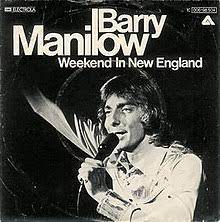
“Weekend In New England” – Barry Manilow
#10 peak (February 26-March 5, 1977)
#65 year-end, 19 weeks on chart
Again, as I mentioned earlier in this list… while Barry Manilow is not the worst thing ever and his songs aren’t even the worst examples in his genre, “Weekend In New England” fails in its attempt to appeal to its audience. It may not be the most overdramatic song of the year, but it is still overdramatic with its cartoonishly sappy bridge, its key change, and its bombastic final chorus. It’s all just too much to handle in one song. And some of the lyrics should have been changed…
When will our eyes meet?
When can I touch you?
…..ick….
Okay, maybe I’m reading too much into this line. But asking to touch a love interest sounds awkward in this context. It’s okay if you like this song, but there is better 70’s orchestral pop out there.
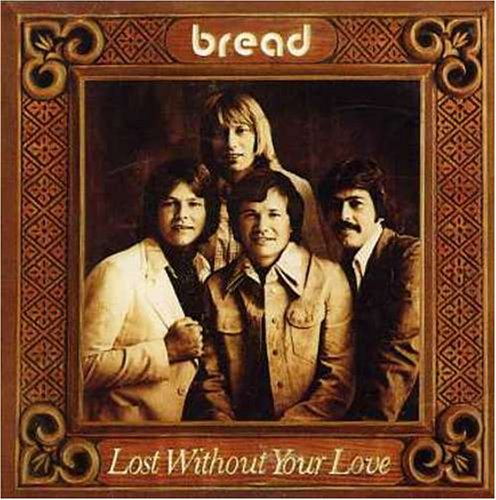
“Lost Without Your Love” – Bread
#9 peak (February 19, 1977)
#70 year-end, 16 weeks on chart
You want to know what a dork I am for 70’s pop music? I like Bread. “Make It With You” is a killer soft rock single. I even enjoy “If” and “Baby I’m A Want You,” as well as some of their rockier album cuts. But then, Bread came back from a 3 ½ year hiatus in 1976 and put out this song, which I listened to for the first time late while going through this list. I always thought Bread was over-hated by people who just hate soft rock acts because they were white and because they played soft rock, but I owe these haters an apology on this one, because “Lost Without Your Love” is as bad as advertised.
Like “Lonely Boy,” “Lost Without Your Love” has a central character who sounds like the biggest problem in life was that he lost to his brother in a game of Mario Kart. It’s about a breakup that causes this man to be so angered and saddened that he can’t even do things on his own anymore.
Lost and all alone
I always thought that I could make it on my own
But since you left I hardly make it through the day
My tears get in the way, and I need you back to stay
Dude. Come on. A breakup is not the end of the world. Go rediscover your hobbies from when you were single. Or go hang out with your family and friends. Quit whining about how terrible your life is because one bad thing happened.
Lost without your love
Life without you isn’t worth the trouble
Really, dude? Based on how this line is, it sounds as if you’re considering suicide over this breakup. Man up and get help. Sheesh.
It’s a shame this was Bread’s final hit song, because David Gates was a talented songwriter, and the band were adept at performing silly love songs with pretty melodies. But none of that is present on “Lost Without Your Love.” Sorry to say it, but it probably would have been for the best had Bread stayed broken up.
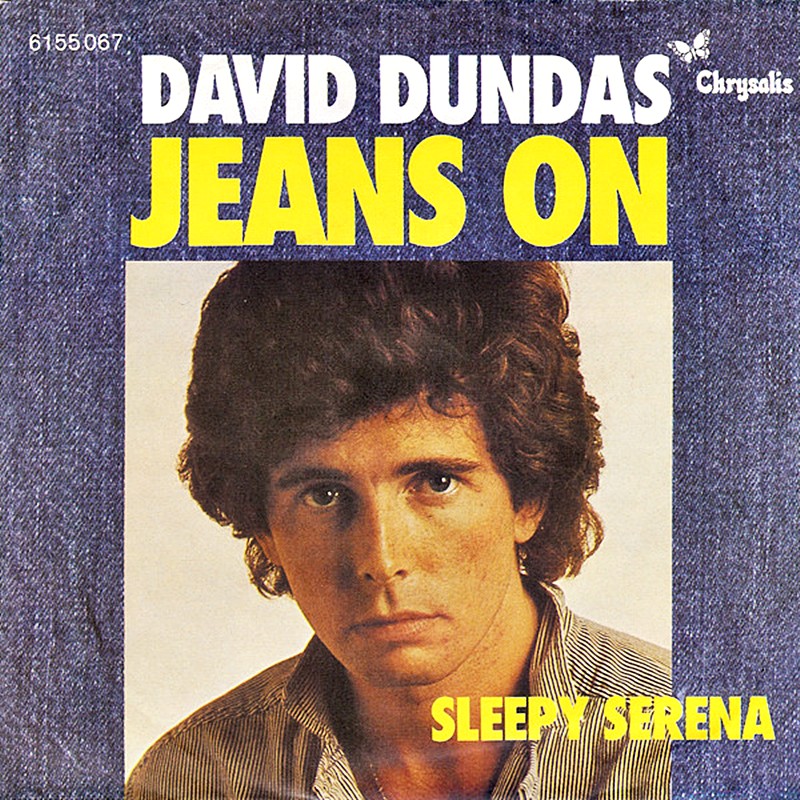
“Jeans On” – David Dundas
#17 peak (January 29-February 5, 1977)
#73 year-end, 22 weeks on chart (17 in 1977)
Hey kids! Tired of those uncomfortable, cumbersome socks you have to wear when you put on your shoes? Try invisisocks! The sock that’s so light and thin, you won’t even feel like it’s there! Try new invisisocks! And with that shameless clothing commercial plug-in, you know where this is going.
David Dundas was a musician and actor who starred in a commercial for Brutus Jeans in 1976, back in his native United Kingdom. The commercial he starred in was so popular, he re-recorded the song for a full-length song and single. And somehow, this was a big hit in the UK, and a smaller, but still respectable hit in the US. I say somehow, because this song has all the feel of a commercial jingle, where the original jingle is practically the whole song and everything else is just incidental.
It’s a shame, because contrary to public opinion, this song had potential. The opening electric piano is distinctive and gives the song a nice groove. But then Dundas sings about his jeans and I just tune out. The phrase “pull on my jeans,” in some way or another, appears 17 times throughout the song. Yeah, the point is made. The song’s about David Dundas putting on his jeans. I ranted long and hard about what mundane songs could be made into effective pop songs in 1963, but this is another example of a subject that shouldn’t have been touched. And I don’t care one bit about the love song lyrics in between the lyrics about jeans, because you just know these lyrics were thrown in at the last minute to make this song about something other than jeans.
Making a TV jingle a full song is a risky idea, because people will always associate your song with the first 30 seconds rather than the full song. I get the same feeling whenever I hear “I’ll Be There For You” by The Rembrandts. But at least it sounds like a complete song, while “Jeans On” is clearly a commercial jingle stretched out to three and a half minutes. Really, guys? Then again, it could be worse. It could have been about wifebeaters.
I put my wife beater on
I put my new wife beater on
Yeesh….
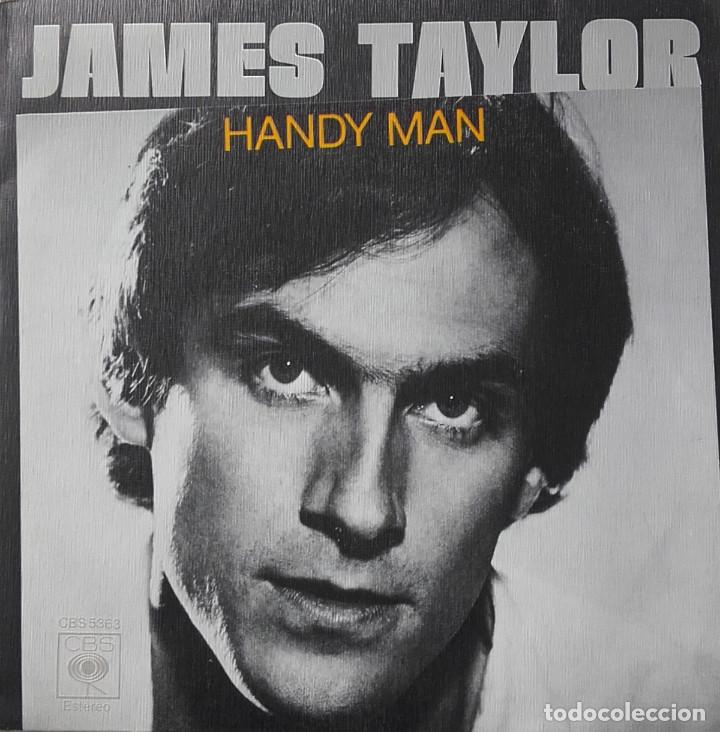
“Handy Man” – James Taylor
#4 peak (September 10-17, 1977)
#46 year-end, 20 weeks on chart
How did James Taylor, the artist with such powerful soft rock songs such as “Fire And Rain” and “Sweet Baby James,” become so lame? That’s the question I’m left to ask after hearing his cover of “Handy Man,” initially released by Jimmy Jones in 1959 (not the Cowboys defensive lineman, the singer-songwriter). Other songs may have been worse, but “Handy Man” is probably the lamest song of the year outside of the top 3 of my worst list.
Taylor has gotten flack over the second half of his hitmaking career for recycling songs that were previously hits for black artists, specifically this, his 1974 cover of Inez and Charlie Foxx’s “Mockingbird” with Carly Simon, and his cover of Marvin Gaye’s first hit “How Sweet It Is (To Be Loved By You),” which was Taylor’s previous hit in 1975. I will say this, I don’t hate those songs. But they did get progressively worse over time. As one of my controversial opinions of the day, “Mockingbird” is on equal footing with the original, and while “How Sweet It Is” isn’t the worst thing ever, it’s nowhere close to the Marvin Gaye version. “Handy Man” sinks one level lower, that being that James Taylor shouldn’t have even touched this song.
Even before you factor in that this is another cover from Taylor, “Handy Man” is a love song built off a cheesy, ridiculous premise. The narrator of the song is a handy man, because he fixes broken hearts. Now combine that with James Taylor’s gentle voice and borderline folk schtick, and it is just ridiculous. James Taylor sang about diverse and personal topics such as New England, friendship, and suicide, not love songs comparing himself to a construction worker you’d find at a hardware store. And then there’s that chorus:
Come-a, come-a, come-a, come-a, come, come
Yeah, yeah, yeah
Really? That’s your chorus? Just two words, one of which sounds like a fake construction tool? James Taylor, at the peak of his powers, decided that this was a good enough song for him to sing? “Handy Man” was dated even during the time of wild disco music and sappy ballads, it didn’t need a misplaced folk singer to make it worse. To summarize, I’ve seen fire, and I’ve seen rain, come-a, come-a, come, come.

“I Like Dreamin’” – Kenny Nolan
#3 peak (March 12, 1977)
#6 year-end, 27 weeks on chart
Kenny Nolan struck it big in 1977, scoring his only two hits this year after previously cutting his teeth as a professional songwriter. Among his surprisingly diverse co-credits are LaBelle’s “Lady Marmalade” (good), Frankie Valli’s “My Eyes Adored You” (mediocre), and “Get Dancin’” by Disco Tex and His Sex-O-Lettes (sucks). After his success, Nolan decided to strike out on his own, with this being his debut single. It became one of the biggest hits of the year. My first assumption would be that this song was carried by radio, since it has gone from the year-end top ten to barely 2 million streams on Spotify as of 2021. That’s stereotypical, but there’s further reason to believe it because I haven’t heard of a single music critic who likes this song. Both this and “Love’s Grown Deep” were pretty bad, but I gave the edge to “I Like Dreamin’” due to its massive popularity and a worse finish.
The song’s premise is kinda cheesy, with the song being about a lonely Nolan fantasizing about being with a cute woman in his dreams, and how he enjoys his dreams since he’s with her and he’s happy with her. But that’s not why the song is here. The song is just bland and boring. It doesn’t have any interesting dynamics, and the subject matter is honestly a subject that’s been covered a million times before. I’m stunned that this was the same guy who co-wrote the vibrant and exciting “Lady Marmalade,” because none of that is present on “I Like Dreamin’.” But there are two things that put it on this list.
One, that harp. Harps are generally never a good sign in a pop song, as they quickly turn songs into grating, excruciating fluff. And this harp is a bad one. It just constantly weaves back and forth in between verses and choruses, kneecapping the pace of the song whenever it enters. We get it, dude. You’re dreaming. You don’t need an over-the-top gimmick to tell us all about it. The second is the ending. You guessed it… this is yet another 1977 song with a key change. There are two in the climax of the song, in fact. If it wasn’t melodramatic in the verses, it’s melodramatic by the time the key changes come in, as it proves that Nolan didn’t know how to end the song. It’s a shame that a talented songwriter with his resumé failed to make it work when he got his chance.

“Torn Between Two Lovers” – Mary MacGregor
#1 peak (2 weeks, February 5 – February 12, 1977)
#10 year-end, 22 weeks on chart
Mary MacGregor was a pop singer from St. Paul, who scored her only hit with this number one smash. Too bad, because this song is not very good. Initially, I expected that this song was going to be one of those boring seventies soft rock songs. Turns out that is only part of the story. This song is about a lot of misconveyed relationship garbage.
To any of you who guessed the meaning of the song from its title, good for you! It’s about a love triangle. Mary is in a relationship with someone but is in love with someone else. And the poor husband don’t get the best introduction to the conflict in the song…
Let me hold you close, and say these words
As gently as I can
There’s been another man
That I’ve needed and I’ve loved
But that doesn’t mean I love you less
You’re having an intimate moment with your partner when you abruptly announce to him that you’re interested in someone else. Wow. I wouldn’t be surprised if he walked out and slept on the couch that night. First off, there’s no way to put this gently. Just like how there’s no way to “gently” lift up and bodyslam someone in WWE wrestling.
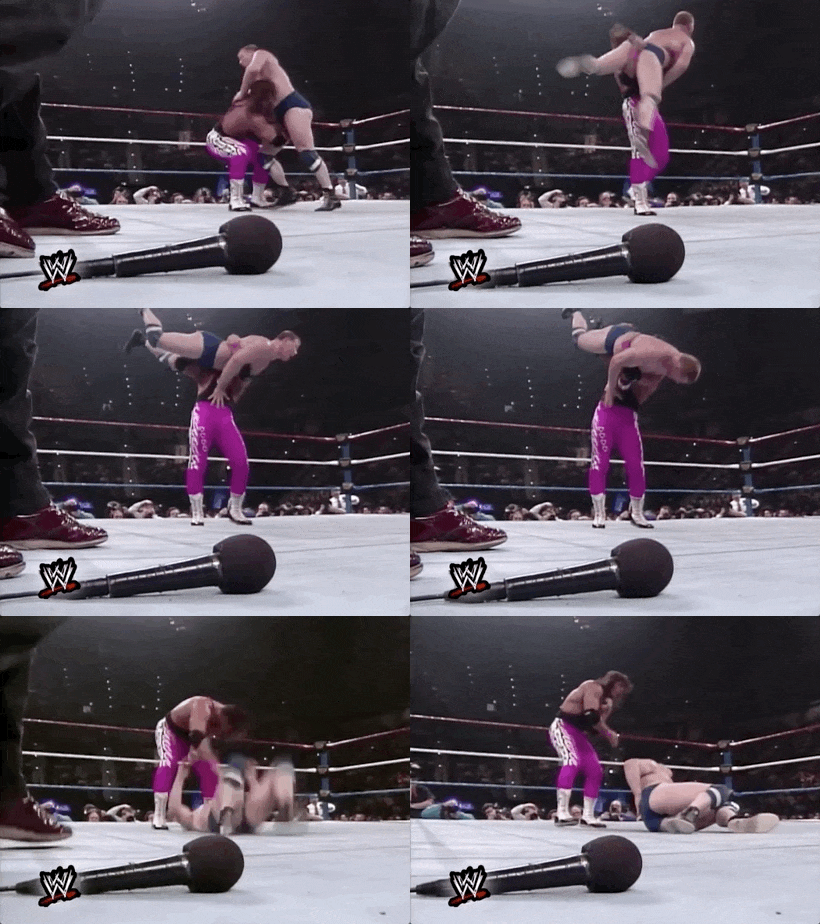
“Very gentle.”
“Yes, very gentle.”
And if you still love your partner, why are you mentioning this? Wouldn’t you just give all your loving to him? Great start, Mary.
And it doesn’t help that the chorus just repeats the same line:
Torn between two lovers, feeling like a fool
Loving both of you is breaking all the rules
I don’t feel bad ripping into this song not just because this song is bad, but also because Mary MacGregor didn’t even like this song. She admitted to getting into fights with co-songwriter Peter Yarrow (he of Peter, Paul, and Mary) over the song, which she found “a boring song to sing,” added that she disliked being constantly asked by fans if she herself personally related to the song, and admitting that the song even contributed to her own divorce. Due to the song’s massive success, she was constantly on tour promoting the record and unable to spend time with her husband, and they divorced the next year. But can you blame her for not liking the record? It’s not only tepid, it’s directionless, as if we don’t know whether to vilify Mary’s character or just tell her, “I can’t help you on this one.” Let’s move on to the next one before I fall asleep.

“Star Wars Theme/Cantina Band” – Meco
#1 peak (2 weeks, October 1 – October 8, 1977)
#71 year-end, 20 weeks on chart (13 in 1977)
Here is the entry on the dishonorable mentions list that I expect a lot of people to get mad at me over. With the atrocious trend of perfectly good songs being turned into disco songs in full swing, the year wouldn’t be complete without a disco version of the biggest film of the year’s main title theme. “Star Wars Theme/Cantina Band” is, as the title suggests, a disco version of the main themes of Star Wars, by Meco, a producer and trombone player who made a living in the late seventies by making disco versions of movie theme songs. And they pretty much all suck, because why are you ruining these great movie themes with a disco hi-hat and bassline? Many in pop music circles have praised this song. If you like this song, fine, but I have to ask, are we listening to the same song?
The main reason I ask this question is because of the execution. Defenders of the song claim that it is arranged to be an effective disco song. All I hear is a slowed down version of the main title theme, with a disco beat under it. When I first heard this song in graduate school, I wanted to cry. Some songs shouldn’t be touched under any circumstance, and John Williams’s legendary opening theme to Star Wars is one of them. Think about the original theme compared to this. The main title theme to Star Wars is titanic and emphatic, as if it’s going to blow you off your seat in regards to how huge the movie you’re about to see is. When you hear this theme in the disco version by Meco, it becomes generic, watered-down, and tepid. What a crime. Adding to it, the further you get into the song, you get some irritating R2-D2 sound effects during the bridge, and the pointless high-pitched voices he would eventually use on “Topsy” are back on his “Cantina Band” portion of the medley. Is there any reason to listen to this, when the original theme is right there waiting for you?
While the saddest thing about the disco version of Star Wars is that it exists when the original was perfect to begin with, another sad thing of note is that many of Meco’s other disco themes, particularly his shambolic Superman theme cover (what did John Williams ever do to you?) and his bizarre “Do The Hustle” inspired version of Judy Garland’s “Over The Rainbow” are even worse. All these disco versions of existing songs did was A) embarrass fans of the original source material, and B) show the same formula over and over again with the same instrumentation, the same tinny guitar following the strings, and the same stupid disco drum pattern. Meco was better off as a producer and session player. Just saying.
And for the last dishonorable mention… Henry, if you’re reading this, I’m sorry.

“Da Doo Ron Ron” – Shaun Cassidy
#1 peak (1 week, July 16, 1977)
#45 year-end, 22 weeks on chart
Yeah, so Shaun Cassidy was a thing in 1977 and 1978, for some reason. Probably because his half-brother David starred in The Partridge Family at the beginning of the decade, and he wanted to try this acting-singing career too. While this is his most remembered song, he had two other hits: “That’s Rock And Roll,” another hit from this year that covered the Eric Carmen song, and “Hey Deanie.”
Let me just state that I don’t truly hate this song. It’s just a cover of the classic song by The Crystals. But therein lies the problem: what was the point of this cover? Nothing distinguishes it from the original. In a good way, at least. Instead of The Crystals’s soulful vocals and splendid harmonies, we get Shaun Cassidy singing karaoke. Instead of Phil Spector’s wall of sound production with its bells and trumpets, we get your average 70s pop song production, complete with a saxophone solo that copies the original note for note. I can listen to this song without cringing, but then I remember I wasted three minutes of my life when I could have listened to the original instead.
So yeah. “Da Doo Ron Ron” didn’t need to exist. It was just a cash grab opportunity for Warner Records to scream, “If you liked David, you’ll LOVE Shaun!,” as well as for people who were beginning to feel nostalgia for the sixties. So if this song is so unessential, then what is Shaun’s defining moment? Well, that came 18 years later in 1995, in Trey Parker and Matt Stone’s woefully underrated short Your Studio And You…
Trey Parker: “Say, Shaun Cassidy!”
Shaun Cassidy: “Who, me?”
Trey Parker: “What do you think about those complimentary [Seagram’s] wine coolers?”
Shaun Cassidy: “I’m blitzed on this stuff already.”
Thank you and goodnight!
Well… except for one dishonorable mention I almost forgot about…

“You Light Up My Life” – Debby Boone
#1 peak (10 weeks, October 15, 1977-December 17, 1977)
25 weeks on chart (9 in 1977)
Ineligible, #3 on Billboard year-end list for 1978
#1 song of 1977 on Cashbox year-end list and American Radio Charts
Again, I agree with the consensus that this is one of the worst number one songs of the seventies. I will go over it when I do 1978. Can’t say that I’m looking forward to it.
Also, screw you Joseph Brooks.
UP NEXT: For those of you who thought there could not possibly be a song from 1977 worse than “Muskrat Love”… prepare yourselves.
MORE BAD 1977 SONGS
The four other eligible songs that rated a 3/10 but just missed the list are:
“You Made Me Believe In Magic” – Bay City Rollers
“Don’t Worry Baby” – BJ Thomas
“Love’s Grown Deep” – Kenny Nolan
“That’s Rock & Roll” – Shaun Cassidy
A list of other terrible songs that were ineligible for this countdown, but primarily charted or were released in 1977…
“Boogie Child” – Bee Gees
“Ain’t Nothing Like The Real Thing” – Donny & Marie Osmond
“Sunshine” – Enchantment
“Whenever I’m Away From You” – John Travolta
“Christine Sixteen” – KISS
“Surfin’ USA” – Leif Garrett
“In The Mood” – Ray Stevens (as Henhouse Five Plus Two)
“Dis-Gorilla” – Rick Dees & His Cast Of Idiots
“Uptown Special” – Shalamar
“Baby Don’t You Know” – Wild Cherry
For future lists from 1974 to 1979, I plan on further expanding the list of eligible songs and include the top 125 songs of the year on the Billboard and Cashbox year-end lists. Had these implications been in place, “Boogie Child” would have been #10 on the list (replacing “Ariel” and “Uptown Special” would have been considered as a dishonorable mention. I may do edits to this list one day to list “Boogie Child” as a #10B.
SOURCES
“Commercial advert – Brutus Jeans (Jeans On) Wrt Roger Greenaway & David Dundas.” Brutus Jeans 1976. Posted on YouTube by saveyourkisses4me, 12 May 2011. Web. 17 June 2022 https://www.youtube.com/watch?v=BKKwXCwrUu4.
Murrells, Joseph. Million Selling Records From The 1900s to the 1980s: An Illustrated Directory. London: Batsford, 1984. Print. 17 June 2022 https://books.google.com/books?id=5iIKAQAAMAAJ. Information gathered from Wikipedia.
Bronson, Fred. The Billboard Book of Number One Hits. Los Angeles: Billboard Books, 2003. Print. 17 June 2022. Pg. 453.
Breihan, Tom. “The Number Ones: Shaun Cassidy’s ‘Da Doo Ron Ron.’” Stereogum 11 November 2019. Web. 17 June 2022 https://www.stereogum.com/2064474/the-number-ones-shaun-cassidys-da-doo-ron-ron/columns/the-number-ones/.
Parker, Trey. “Your Studio And You.” Universal Pictures 1995. Short Film. 17 June 2022.
IMAGE SOURCES
“You And Me” single cover from IMDb
“Lonely Boy,” “Weekend In New England,” and “I Like Dreamin’” single covers, and You Light Up My Life album cover from Wikipedia
Image of Simple Plan from The Beijinger
Lost Without Your Love and Star Wars And Other Galactic Funk album covers from Amazon
“Jeans On” single cover from Dutch Charts
Image of man wearing a wife beater shirt from Quora
“Handy Man” single cover from TodoColeccion
“Torn Between Two Lovers” and “Da Doo Ron Ron” single covers from Stereogum
GIF of Bret Hart body slamming a poor wrestler from the WWE. GIF taken from GIPHY.
 Dr. Nelson Winston
Leave a comment